A K-beauty video can show a beautiful bottle, a trending audio track, and flawless skin—and still leave the viewer with no reason to trust the product. The missing piece is usually not production polish. It is credible product proof: who the product is for, how it fits into a routine, what the creator can honestly demonstrate, and whether the language sounds natural to the intended audience.
That is the real job of UGC for Korean beauty (K-beauty) marketing. It should turn product information into a believable viewing moment without turning a creator into a scripted spokesperson. For campaigns aimed at South Korea, it also needs Korean-language judgment, local viewing context, and claim boundaries that survive adaptation.
This playbook is for global skincare and beauty teams planning Korean-market creative. It explains how to choose a campaign angle, build proof into the format, brief a Korean creator, define usage rights, and test useful variations without duplicating a general creator-hiring guide.
First decide what “K-beauty” means in this campaign
Teams often use “K-beauty marketing” to describe two different projects. One is marketing a Korean beauty product to buyers in another country. The other is marketing any beauty product to consumers in South Korea. Both may use UGC, but they require different creative decisions.
For a global K-beauty campaign, the creator may need to explain an unfamiliar routine, ingredient story, or product format to an overseas audience. The priority is translation of product knowledge into local buyer language.
For a campaign targeting Korea, the priority is different. The brief must account for natural Korean speech, local product expectations, platform behavior, approved Korean terminology, domestic product availability, and the way the CTA will actually be used. A Korean creator can help with these decisions, but nationality or location alone does not prove campaign fit.
Write one sentence before production: “This content is for [specific viewer] in [market], and it should help them [understand, compare, trust, or act].” If the team cannot agree on that sentence, it is too early to choose hooks or creators.
What makes UGC for Korean beauty marketing credible?
Credibility comes from three types of proof working together.
Physical proof
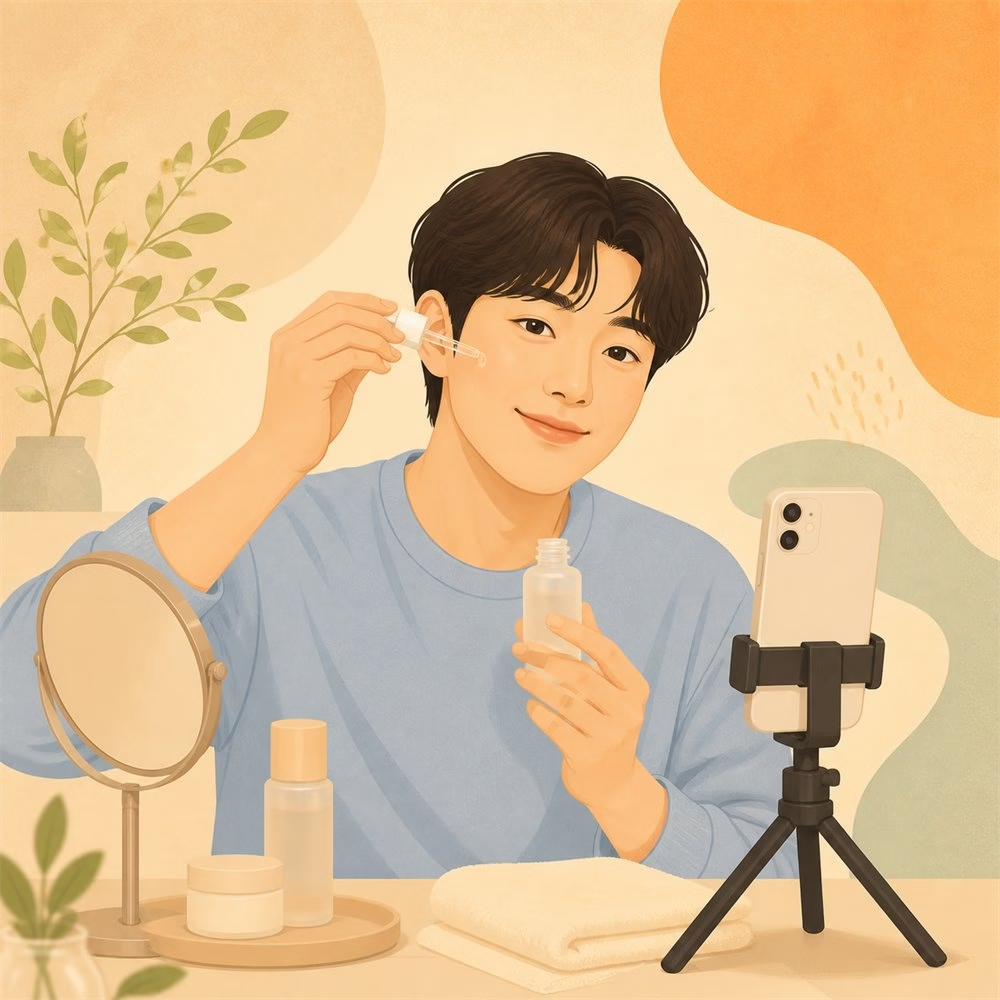
Beauty viewers want to see the product behave. Useful footage may show texture, amount, spread, finish, packaging mechanics, shade, or how the item fits into a routine. Stable lighting and limited filtering matter because the visual is part of the claim.
A beauty UGC strategy guide from Refunnel emphasizes that skin type, product category, and the time needed to observe a result should influence creator selection and content design. A first-use video can honestly discuss texture or immediate feel; it should not be edited into a long-term testimonial.
Contextual proof
The viewer should understand when, why, and for whom the product is useful. A routine clip is stronger when it answers a real decision: when to apply the product, what step it replaces, how it layers, or what concern led the creator to try it.
Skeepers’ review of K-beauty UGC patterns highlights routines, honest reviews, step-by-step education, texture, and ingredient storytelling. These are not automatic winning formulas. They are useful format families because each can make one part of the product experience visible.
Linguistic proof
For Korean audiences, correct translation is only the baseline. The hook, sentence endings, product terms, emotional intensity, and CTA need to sound like something the intended viewer might actually hear from a creator. A technically accurate script can still feel imported if it follows English sentence rhythm or overstates enthusiasm.
The final wording must also preserve the brand’s approved meaning. A creator should not strengthen “helps support” into a guaranteed outcome or turn a cosmetic benefit into a medical statement. Product truth should be locked before stylistic adaptation begins.
Which K-beauty UGC formats should you test?
Choose formats by the question the viewer needs answered, not by a list of current trends.
- Routine placement: Show where the product belongs and what comes before or after it. Use this when order, convenience, or compatibility creates uncertainty.
- Texture and application: Show amount, consistency, spread, absorption, or finish in stable conditions. Use this when the physical experience is central to purchase.
- Concern-led explanation: Begin with a familiar situation, then connect it to one approved product benefit. Keep the concern specific without presenting a diagnosis.
- Ingredient translation: Explain one ingredient or product mechanism in plain language supplied or approved by the brand. The creator simplifies; they do not invent science.
- First-use observation: Cover packaging, scent where appropriate, texture, application, and immediate feel. Label it honestly as a first impression.
- FAQ or comment response: Answer a real buyer objection such as stickiness, routine order, shade, fragrance, or portability.
- Comparison of use cases: Compare two routines, application methods, or audience needs without making unsupported superiority claims.
A self-reported LG H&H multi-brand TikTok case study describes routine-led, education-first content and close product demonstrations across several beauty brands. The useful lesson is operational: a shared system can still allow each product to have a distinct proof point. Treat the reported performance as the publisher’s case data, not as a guaranteed benchmark for another campaign.
How do you write a Korea-ready creator brief?
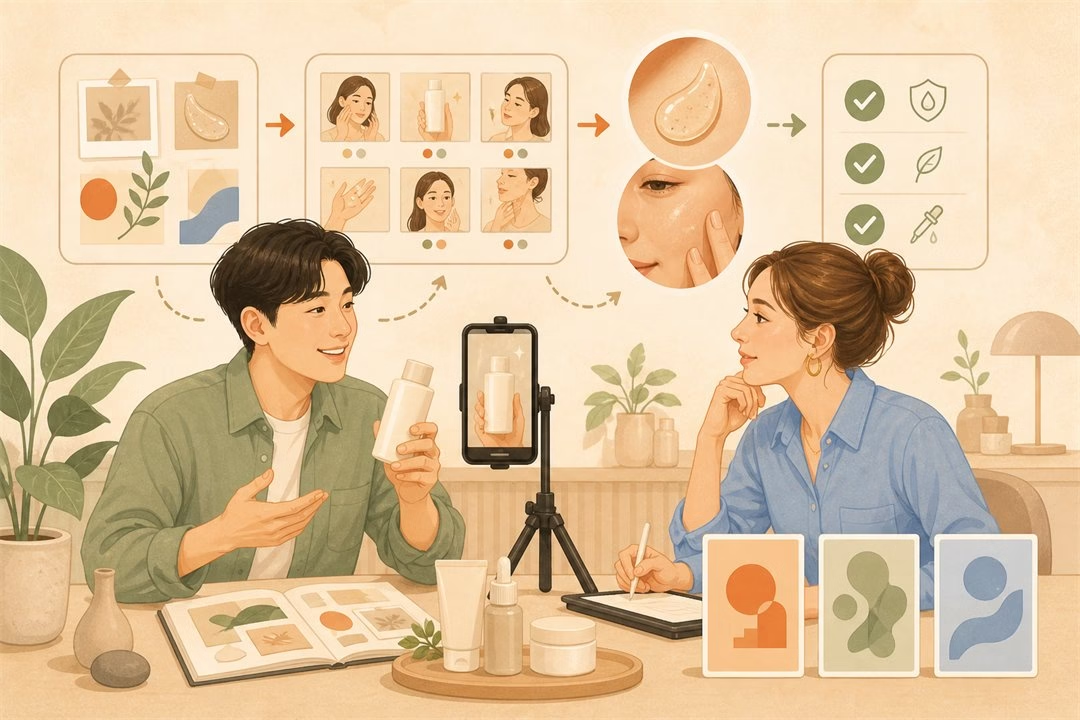
A good brief protects product truth while leaving room for a natural performance. It should tell the creator what must be accurate, what must be visible, and what can be interpreted.
Include these items:
- Audience and market: Define country, language, age range, relevant concern, and purchase stage.
- Campaign job: State whether the asset should educate, demonstrate, answer an objection, support a product page, or drive a paid click.
- Approved product truth: Supply product use, approved benefits, hero ingredients, evidence available, and prohibited claims.
- Korean terminology: Confirm product-name pronunciation, ingredient terms, caption style, and the intended level of politeness.
- Creative beats: Define the problem, product moment, proof, and next action without writing every gesture.
- Required shots: List only the packaging, texture, application, routine, or close-up shots needed for the campaign job.
- Technical delivery: Confirm orientation, duration, resolution, safe areas, subtitles, clean version, raw footage, and file naming.
- Commercial scope: Specify channels, organic or paid use, region, usage period, editing permission, creator-account posting, and renewal terms.
- Review process: Separate factual corrections from creative preferences and state how many feedback rounds are included.
If you are still choosing a creator, use the related guide to hiring a Korean UGC creator for skincare brands for portfolio, claim, lighting, and pilot criteria. This article focuses on what happens after the campaign direction has been chosen.
How much creative freedom should the creator have?
“Be authentic” is not a brief, but a word-for-word script is not automatically safer. The practical answer is controlled freedom.
Lock the facts: product use, approved benefits, pronunciation, required disclosure, prohibited claims, mandatory visuals, and CTA destination. Then let the creator adapt the hook, sentence rhythm, gestures, and explanation order within those boundaries.
Ask for a short concept or Korean read-through before filming when the language carries product risk. This review is cheaper than discovering after production that the content is accurate on paper but unnatural on camera.
Creative freedom should also match the creator’s assignment. A creator hired only to produce assets can be evaluated on delivery, filming, editing, and usability. An influencer expected to publish adds a separate distribution decision involving audience fit, disclosure, timing, and reporting.
How should usage rights and deliverables be scoped?
Do not use “one UGC video” as the complete scope. A twenty-second master, three opening hooks, raw clips, a clean version, subtitles, still frames, and six months of paid advertising are different deliverables and rights.
Confirm these points in writing before filming:
- final edits and duration;
- alternate hooks, CTAs, or product shots;
- raw-footage and re-edit permission;
- organic channels and paid advertising channels;
- territory and license period;
- creator-account posting or whitelisting, if needed;
- music, subtitle, and caption responsibilities;
- revision rounds and reshoot conditions;
- renewal terms after the initial license.
The guide to hiring a TikTok UGC creator based in Korea explains the production-versus-distribution distinction in more detail. It is worth resolving before comparing creator prices because an inexpensive production fee may not include the rights the media plan requires.
What should the first K-beauty UGC test include?
Start with a pilot that can teach the team something. One useful structure is one creator, one product truth, one core body, and three meaningfully different hooks.
For example, the same product demonstration could open with:
- a routine problem the viewer recognizes;
- a visible texture or application moment;
- a direct answer to a common product question.
Keep the body and offer stable enough to compare the opening ideas. Do not change creator, hook, proof, duration, CTA, and audience at the same time and then attribute the result to one factor.
Review the pilot in two layers. First, complete the quality gate: natural Korean, correct product use, accurate claims, clear visuals, required disclosures, correct files, and agreed rights. Second, evaluate performance using the metric that fits the placement. A thumb-stop or hold metric can help diagnose the opening; completion can help diagnose pacing; clicks or landing-page behavior may reveal whether the promise and CTA align. No single metric proves that the entire creative system works.
Does a K-beauty UGC creator need to be Korean?
Not for every K-beauty campaign. If a Korean product is being marketed to consumers in another country, a local creator who understands that audience may be the right choice.
If the target audience is in South Korea and the content is meant to feel locally native, Korean-language delivery and cultural judgment become central. A Korean creator based in Korea can also help with domestic product delivery and locally grounded settings. Even then, assess the portfolio, category fit, brief interpretation, production reliability, and rights—not identity alone.
The best choice is the creator who can credibly represent the intended viewer and deliver the proof the campaign requires.
Build a repeatable Korean beauty UGC system
Effective UGC for Korean beauty (K-beauty) marketing is not a collection of pretty product clips. It is a controlled system: define the market, choose one viewer decision, show honest product proof, adapt the message naturally, protect claim boundaries, confirm usage rights, and test variations that produce clear learning.
If your team needs a Korean creator who can adapt a global beauty brief, present products naturally in Korean, and deliver short-form assets for brand-owned or paid use, review the Korean UGC production service and share the product, target viewer, intended channels, deliverables, and usage period in the project form below.