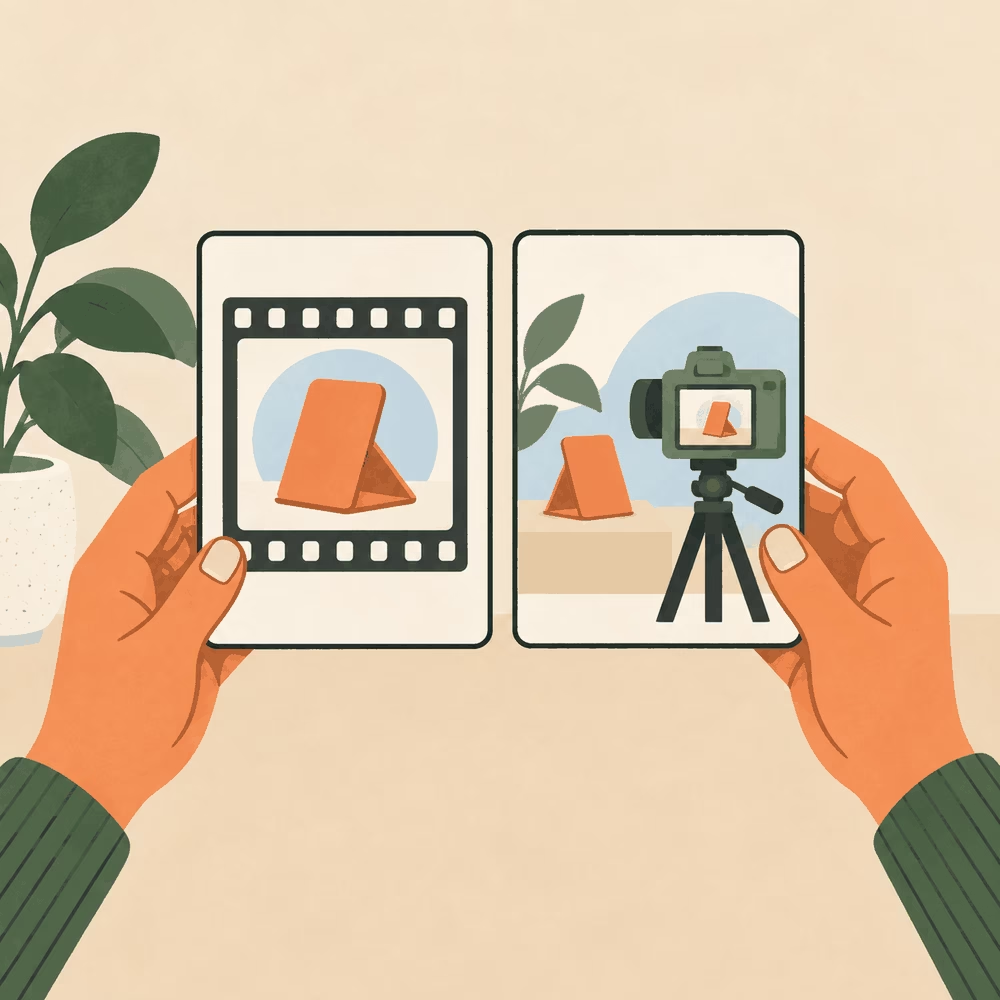
Your English UGC video shows a useful product demonstration. For Korea, should you adapt the existing cut or film it again? A new Korean voice track can change the explanation. It cannot establish that the product shown is the version customers will receive.
The useful comparison in video localization vs reshooting is not “cheap versus authentic.” It is which parts of the existing recording still support the approved Korean message—and which require new evidence.
Start with the shot that is hardest to reuse. You may find that the original cut works, that a few pickup shots solve the problem, or that the central performance needs a new shoot. Here is how to make that choice without treating every market version as a full production.
What are you actually changing: words or the thing on camera?
Separate the language layer from the evidence in the picture. Narration, captions, and editable graphics can be adapted without necessarily changing the underlying footage. A different product mechanism, unavailable app feature, or new demonstration is another kind of change.
Watch the source cut without its script. Write down what each shot visibly establishes. “A hand adjusts the hinge” is a useful observation. “The product is easier to use” is an interpretation that the shot may not establish.
Next, compare the observed action with the product and message approved for Korea. Check the actual product version, screen, accessory, and destination. Do not choose reuse because the file is available; choose it because the footage remains relevant and accurate.
For a fuller editing workflow after you have made that decision, see our video ad localization guide. This comparison focuses on retaining footage versus commissioning new shots, not on choosing subtitles or narration.
When is video localization vs reshooting mainly a language decision?
Reusing the footage is a sensible starting point when the same product action remains visible and accurate, the source performance can be used for the intended version, and the language-dependent elements can be changed cleanly.
A product close-up with off-camera narration gives an editor different options from a face speaking continuously to camera. In the close-up, a Korean line can be recorded against the action, with timing adjusted through useful supporting shots. Visible speech also requires a decision about the relationship between the new voice and the original mouth movements.
Review a representative difficult segment before committing to the whole version. Include the longest Korean line, a product action, and any graphic that needs replacement. A clean opening does not establish that the rest of the cut can be adapted.
Tools also have different boundaries. Perso’s video-ad workflow separates dubbed dialogue and subtitle delivery from edits to text embedded in the picture. That distinction matters regardless of your tool: changing speech is not the same as replacing every visual.
Do not assume dubbing, voice cloning, or lip modification is already covered by permission to use the original file. Confirm the intended adaptation with the relevant owner or performer before commissioning it. A new recording is an option to scope, not an automatic workaround for an unresolved permission question.
When should the product demonstration be filmed again?
New footage is worth considering when the existing picture cannot honestly show the product or task you need to explain. Changing the narration while retaining contradictory evidence does not resolve the mismatch.
Educational demonstration, not a client project: imagine an English ad for a folding phone stand. The original model adjusts through a side button. The approved version for the Korean campaign uses a different hinge and no side button.
A Korean line such as “옆면 버튼을 눌러 각도를 조절하세요”—“Press the side button to adjust the angle”—fits the old shot but describes the wrong model. Replacing it with “각도를 조절해 보세요”—“Adjust the angle”—removes the button instruction, yet the picture still teaches an action customers cannot perform on the new stand.
The repair is a fresh close-up of the actual adjustment. Write the Korean direction after confirming that action, not by guessing from the old footage. Keep the hand, product, and result visible long enough for the explanation to be understood.
This is a production judgment about the fictional example, not a claim that reshooting always performs better. If the same mechanism exists on both versions, a new shoot may add little. The decision changes when the visible evidence changes.
Can pickup shots solve it without a full reshoot?
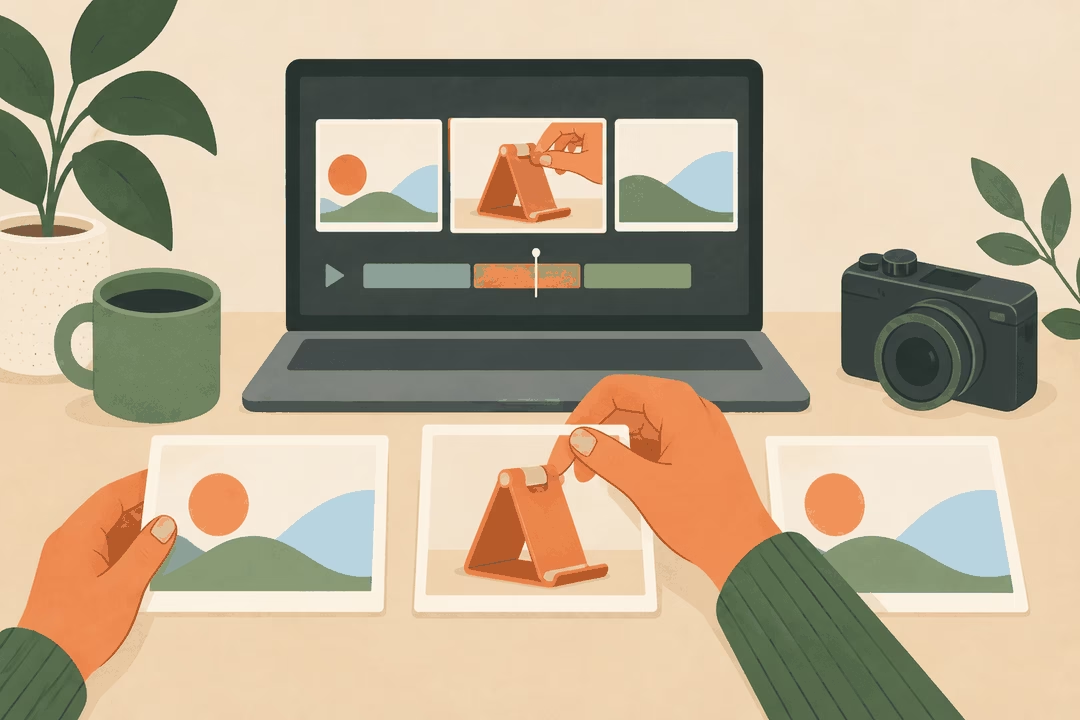
Often the relevant question is how much of the cut needs replacing. A new demonstration does not necessarily require a new opening, closing, location, and performer.
Make a simple shot disposition for the current cut:
- Retain: the footage still shows the right product or context and supports the approved message.
- Adapt: the picture remains accurate, but its narration, editable graphics, or timing needs a Korean version.
- Replace: a specific shot shows the wrong model, action, or unavailable screen.
- Hold: product facts, permissions, or source assets remain unresolved.
For the fictional phone-stand cut, a general desk scene might be retained if the relevant product details remain accurate. The adjustment close-up needs replacement. A closing shot may need replacement too if it clearly shows the old hinge. Inspect each shot; do not classify the whole video from one screenshot.
Give the pickup brief the preceding and following shots. Match the direction of the action, product position, framing, and continuity needed for the edit. If the original speaker remains visible around the replacement, plan how the cut transitions into and out of the close-up.
A pickup is not automatically a bargain. Product delivery, continuity constraints, unavailable raw files, or repeated revisions can make a small-looking change difficult. Compare the scoped work, not just the number of new shots.
What makes a new Korean performance worth considering?
A new performance can be useful when the concept depends on spoken interaction, a demonstration that cannot be separated from the speaker, or a story that needs rewriting rather than substituting words.
For example, an opening built around a particular personal anecdote cannot simply be reassigned to another creator as their real experience. A new scripted demonstration can describe a task without inventing that history. Label an illustrative performance appropriately and keep the claims tied to what the product and script support.
Likewise, do not choose a Korean creator solely to make a video “look Korean.” Define the actual role: explaining a specific task, speaking naturally to the intended audience, showing the available product, or delivering a new concept. Those are reviewable production needs.
A new shoot also introduces new choices. Agree the script direction, product access, required scenes, deliverables, and review scope before filming. Retain what was useful in the original concept without claiming that its previous campaign result will transfer to a new audience or performance.
How do you compare the two routes fairly?
Give both approaches the same approved message, product version, target placement, and required deliverables. Otherwise, you may compare a simple language version with an entirely new creative concept and mistake the difference for a production-method effect.
For the reuse route, include asset recovery, Korean copy, recording, graphics, edit adjustments, and review. For the new-footage route, include briefing, product access, filming, editing, and review. Add the actual unresolved dependencies to each scope.
Ask what the estimate assumes. Is the project editable? Are clean shots available? Does the quote cover just raw footage or a finished cut? Who approves the product demonstration? Use project-specific estimates rather than generic online price ranges.
Production QA and campaign measurement answer different questions. QA establishes whether the delivered version is accurate and usable. Performance testing asks whether it works for the intended audience and objective. If you compare versions, document changes in the hook, offer, audience, and destination; a result cannot isolate reuse versus reshooting when all of those change together.
Where should you start before booking a shoot?
Start with one current cut and the hardest-to-reuse shot. Confirm what the picture proves, what the Korean version needs to say, and what source assets you actually have. Then decide whether to adapt that shot, replace it, or change the concept.
Video localization vs reshooting is a choice about the evidence and performance you need to create—not a rule that every imported ad needs replacing. A targeted pickup can sit between the two, while a new shoot may be the clearer option when the central demonstration or story must change.
If you need a Korean performance or fresh product shots, explore our Korean UGC filming and video production. Share the existing cut, the product version, and the shot you cannot reuse through the project form below. We can agree whether the scope calls for raw footage, a finished video, or a combination of new filming and supplied material.