

A UGC ad can feel effortless in one market and obviously staged in another. The camera quality may be good, the product may be visible, and the translation may be technically correct—yet a Korean viewer can still sense that the situation, delivery, or call to action was built somewhere else.
That is the real challenge behind Real Korean UGC for social media ads. “Real” does not mean unplanned, low-quality, or completely unscripted. It means the creator, language, behavior, visual proof, and ad format work together in a way that feels locally credible while still giving a marketing team usable creative assets.
This guide shows global brands how to choose the right creator, prepare a Korean UGC brief, request testable variations, define usage rights, and review the first draft without confusing personal taste with ad readiness.
What does real Korean UGC mean for a paid ad?
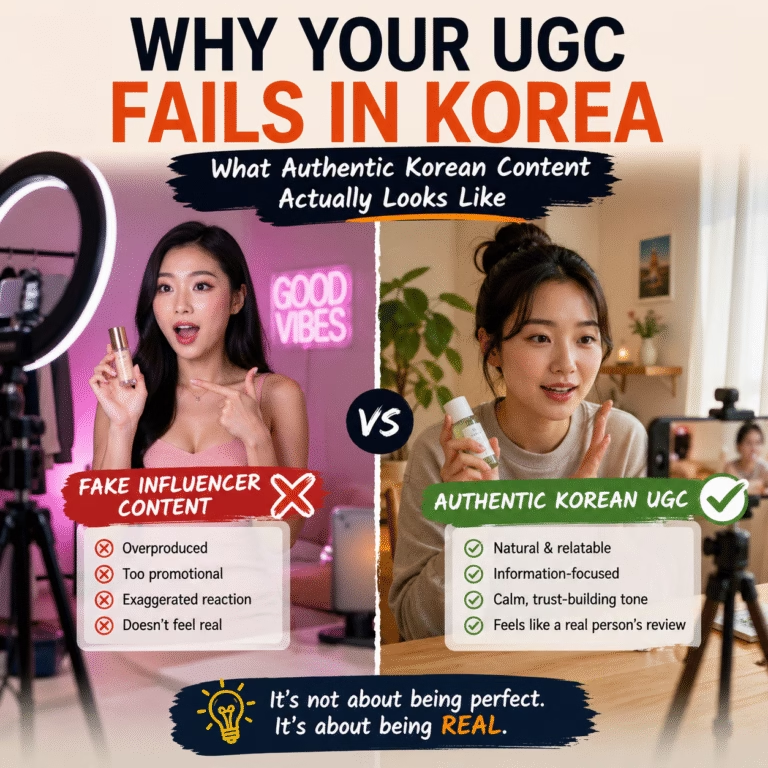
Real Korean UGC should feel like a believable recommendation, demonstration, or reaction from a person the target viewer could reasonably trust. The viewer should not have to mentally translate the scene before understanding why the product matters.
That local credibility usually comes from several small decisions:
- The creator resembles the intended user in age, role, energy, and situation.
- The Korean sounds spoken rather than written, with the right level of politeness for the category and audience.
- The problem appears in a familiar context instead of being explained through a generic advertising claim.
- The product proof is visible and timed to the spoken message.
- The call to action continues the creator’s tone rather than suddenly switching into brand language.
This does not require every video to look casual. A finance app, beauty product, game, food brand, and B2B tool may need different levels of polish. Authenticity is not a visual filter; it is alignment between the person, situation, message, and placement.
If you are still defining what local authenticity should look like, the guide to authentic Korean influencer-style UGC explains the broader cultural problem. This article focuses on turning that principle into ad-ready production decisions.
Why do Korean UGC ads still feel translated?
Many global teams start with a successful English asset and ask a Korean creator to reproduce it line by line. The concept may be worth keeping, but the exact delivery often is not.
Common warning signs include:
- A hook that is grammatically correct but too long to sound spontaneous.
- A sudden switch between formal product language and casual creator speech.
- An emotional reaction that does not match the product category or the creator’s natural energy.
- Captions that preserve English sentence order instead of following Korean emphasis.
- A broad claim with no visual proof, followed by an aggressive sales CTA.
- A creator asked to imitate the pacing, gestures, or humor of the original performer.
In Korean IT marketing and Korean UGC production, one recurring mistake I observe is treating localization as a final script check. By that stage, the casting, scene, proof, and edit rhythm may already be fixed. A native sentence cannot rescue a concept that asks the wrong person to show the wrong moment.
Keep the original ad’s useful strategic core: the audience problem, the product proof, and the desired action. Then rebuild the spoken line and performance around the Korean viewer. For a broader production sequence, see the UGC step-by-step guide for agencies entering Korea.
Choose creator fit before writing the script
Follower count is not the main selection criterion when the brand will run the content through its own ad account. The creator’s production and communication skills matter more than the size of an audience that may never see the asset.
Review candidates against the actual ad job:
- Viewer fit: Could the target buyer recognize this person as a plausible user, peer, expert, or recommender?
- Natural delivery: Can the creator explain a benefit without sounding like they memorized brand copy?
- Category fluency: Do they understand what must be shown, pronounced, or handled carefully?
- Visual proof: Can they film useful close-ups, demonstrations, reactions, screen actions, or environmental details?
- Production discipline: Can they follow aspect ratios, file naming, raw-footage, deadline, and revision requirements?
- Collaborative judgment: Can they flag an awkward Korean line instead of recording it exactly and waiting for a revision?
For software and product-demo work, category understanding becomes even more important. The Korean SaaS UGC creator hiring guide covers demo accounts, interface footage, and product-accuracy review in more detail.
How do you brief Real Korean UGC for social media ads?
A useful brief gives the creator a clear destination without scripting every step of the journey. Start with one audience, one use case, one central claim, and one desired action.
Separate the brief into two layers.
The fixed layer contains information that must remain accurate: approved product facts, prohibited claims, pronunciation, mandatory disclosure, visual requirements, offer details, and the exact end action. The flexible layer gives the creator room to choose natural connective language, gestures, and examples that fit the Korean audience.
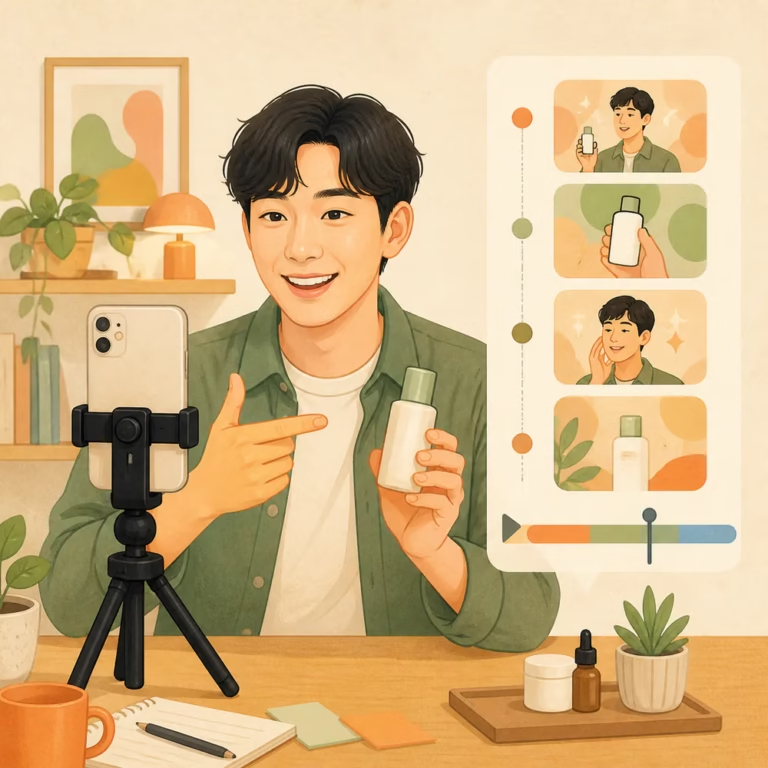
Then define what the editor needs, not only what the creator should say:
- Two or three short hook options aimed at the same audience problem.
- A face-on-camera opening if trust depends on the creator.
- Product or interface proof that matches the main claim.
- Clean B-roll with enough hold time for alternate edits.
- A natural primary CTA and one approved variation.
- A caption-safe frame with important visuals away from platform controls.
- A clean ending that can support different crops or overlays.
Avoid asking one short video to communicate every feature. If you need several messages, create separate concepts. A creator who must cover six benefits in twenty seconds will usually sound more like a presenter than a user.
Build variants without making the video feel manufactured
Paid social teams need options, but excessive scripting can remove the exact quality that makes UGC useful. The solution is modular footage, not multiple rigid performances.
For one core concept, a practical starting package might include three hooks, one main story, two product-proof sequences, and two closing lines. The brand can test different openings and endings while keeping the creator’s central explanation intact.
Clarify whether the creator delivers finished edits, selected clean clips, or full raw footage. These are different deliverables. Raw footage can be valuable for iteration, but it should not be assumed, and the brand should agree on how it may be edited and reused.
Platform placement also affects the request. A fast vertical ad may need a stronger first frame and tighter caption area than a landing-page video. A mobile app campaign has its own proof and pacing requirements; the Korean UGC video ads for mobile apps guide shows how the path from scroll to install changes the creative job.
Review authenticity and paid-social readiness separately

Do not approve a Korean UGC draft in one pass. A video can feel natural but provide weak ad material, or it can contain every required shot while sounding forced.
First, review local credibility:
- Does the Korean sound like speech rather than translated copy?
- Is the level of politeness right for the audience and category?
- Does the creator’s reaction match the claim?
- Does the setting make the use case believable?
- Does the CTA sound like the same person who delivered the rest of the video?
Second, review paid-social readiness:
- Is the audience problem clear in the opening moment?
- Does the product appear early enough to connect the story to the offer?
- Is each claim supported by visible proof?
- Are the shots steady, clean, and long enough for alternate edits?
- Can captions be read without covering the face, product, or interface?
- Are music, footage, props, and locations safe for the agreed commercial use?
Feedback should point back to the brief. “Use the second hook and show the product before the reaction” is actionable. “Make it more viral” is not.
Define usage rights before filming
UGC production and influencer posting are different purchases. A content-only creator can make the asset without publishing it to a personal audience. An influencer agreement may include both production and distribution. Separate those scopes before comparing price.
Write down:
- The brand channels and ad accounts that may use the asset.
- Whether use is organic, paid, or both.
- The duration and territory of the license.
- Whether the brand may crop, caption, translate, combine, or re-edit the footage.
- Whether raw footage is included.
- Whether creator-account advertising or whitelisting is required.
- Whether the creator must post the content personally.
- Which party handles required ad or sponsorship disclosure.
This is a production checklist, not legal advice. The purpose is to eliminate assumptions before filming, when scope changes are easier to discuss.
A practical pre-production checklist
Before the creator records, confirm all of the following:
- One Korean audience and one recognizable use case.
- One claim that the video can actually prove.
- A creator chosen for audience and category fit, not appearance alone.
- Fixed product facts separated from flexible Korean delivery.
- Hook, proof, B-roll, CTA, caption, and technical requirements.
- Approved claims, prohibited language, pronunciation, and disclosure notes.
- Deliverables, revision rules, deadlines, and file formats.
- Paid and organic usage rights, duration, territory, and editing permissions.
- A review owner for product accuracy and a review owner for Korean naturalness.
If several items are still unclear, delay filming. A short alignment step costs less than reshooting a video that was produced correctly against an incomplete brief.
Frequently asked questions
Can we translate a winning English UGC ad into Korean?
Use the original as strategic evidence, not as a performance template. Keep the audience problem, proof, and conversion goal when they remain relevant. Rewrite the hook, connective language, examples, and CTA so they sound natural for the Korean creator and viewer. Also check whether the original setting and behavior make sense in Korea.
Do we need a Korean influencer or a UGC creator for paid ads?
Choose a content-focused UGC creator when the main deliverable is an asset for the brand’s own ads, website, or social channels. Choose an influencer when access to the creator’s audience is part of the goal. One person may offer both, but production, posting, usage rights, and measurement should still be scoped separately.
Turn local credibility into testable creative
The best Real Korean UGC for social media ads is not simply the least polished video. It is a locally credible performance built from a clear audience, a focused claim, visible proof, useful variants, and agreed commercial rights.
My work combines Korean IT marketing, Korean UGC creation, Korean-market content production, and collaboration with global clients. That makes it possible to review the message, on-camera delivery, and practical ad requirements as one connected project.
If you need a Korean creator who can help shape the brief as well as record the content, review my Korean UGC creation service. Send the product link, target audience, intended platform, main claim, and planned usage period. I can help turn those inputs into a focused Korean UGC concept that is easier to produce, review, and test.

Pingback: Korean UGC Creator for Ecommerce Product Launches