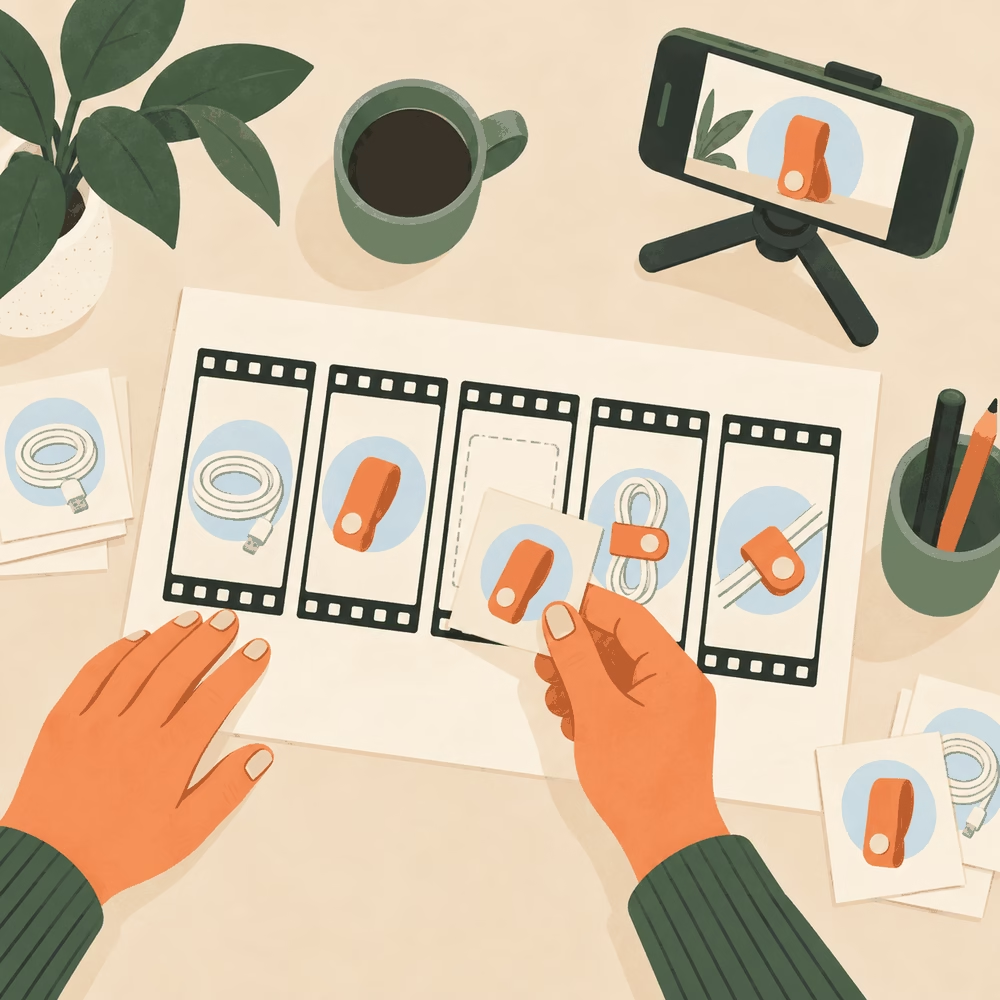
A creator receives your script, films a tidy product sequence, and sends the footage. Only in the edit do you discover that the hand covers the fastening step, the Korean sentence describes a different action, and there is no clean closing shot.
A useful UGC storyboard template catches those gaps before filming. It connects each picture with the exact spoken line, caption, and edit requirement—not just a box labelled “product demo.”
Below is a filled example for a 20-second Korean product ad, followed by a reusable shot record. This is an educational demonstration for a fictional reusable cable strap, not a client campaign, recorded performance, or tested winning ad. The timings are planning allocations that still need a Korean scratch read and rough cut.
What should a UGC storyboard template contain?
Give every shot a stable ID and keep six decisions together: its position in the edit, what the camera must show, what the speaker says, what appears as a subtitle, any separate graphic text, and what the editor needs to assemble it.
A note such as “show how easy it is” leaves the central action undefined. “Keep the strap closure visible as the hand presses it shut” gives the creator something filmable and the reviewer something observable.
StudioBinder’s commercial storyboarding guide illustrates using panels, action direction, and collaborative review. For this Korean UGC example, add a language layer beside the action: approved spoken Korean plus an English back-translation for the global reviewer. The back-translation is a review aid, not an extra subtitle to burn into the video.
The sample assumes a vertical product demonstration with off-camera narration, a reusable hook-and-loop strap that actually closes as shown, and a product page containing the promoted variant’s dimensions. These are fictional brief assumptions. Confirm them against your real product before adapting any line.
What does the filled 20-second storyboard look like?
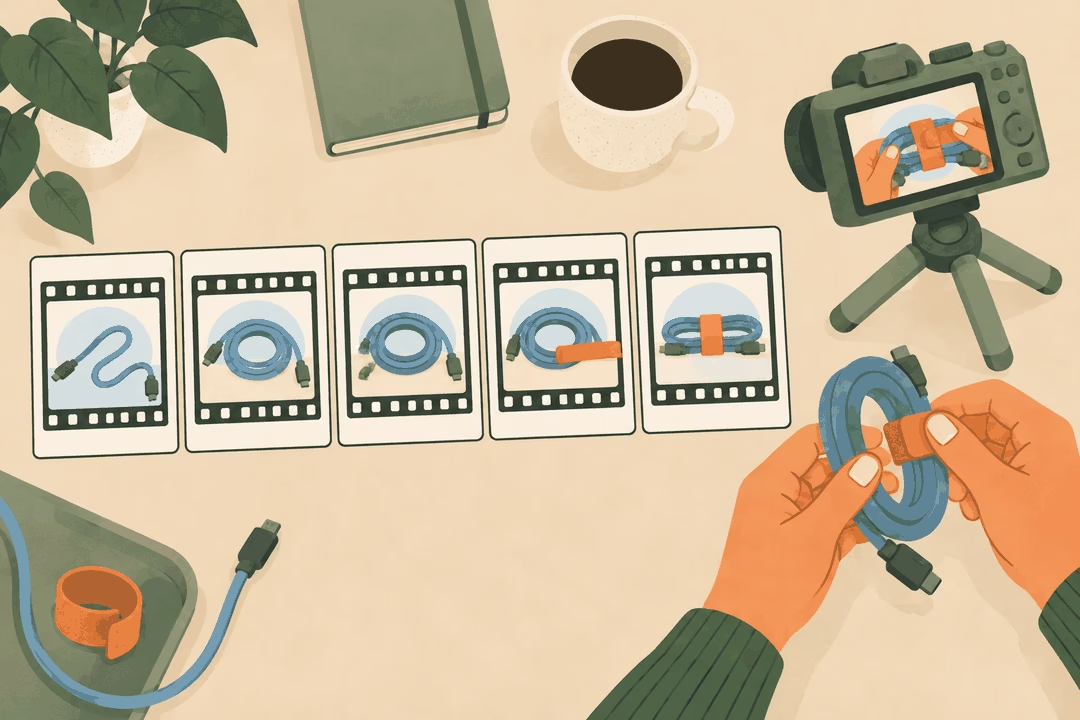
The five shots below form one complete demonstration. Read them in edit order. Each subtitle is the proposed Korean speech, not a competing headline; line breaks and cue boundaries must be set against the selected recording.
S01 — 0:00–0:03: show the loose cable
Picture: A hand lifts a loosely coiled cable from a desk. The coil visibly opens. Use the actual cable and avoid an exaggerated tangle that the product never addresses.
Spoken Korean / subtitle: “케이블, 또 풀렸네요.”
Back-translation: “The cable has come uncoiled again.”
Separate graphic: None.
Edit instruction: Keep the opening coil and its release in the same readable action. The line describes the staged event on screen; do not add a claim that the creator has struggled with this for years. Record a clean start before the hand enters.
S02 — 0:03–0:07: introduce the strap
Picture: The hand places the orange strap beside the same blue cable, then brings the cable ends together. Frame both objects without covering the strap.
Spoken Korean / subtitle: “이 스트랩으로 묶어볼게요.”
Back-translation: “I’ll try bundling it with this strap.”
Separate graphic: None.
Edit instruction: Match the cable position at the end of S01. Let the object become identifiable before the next close-up. Keep product naming consistent with the approved Korean product page; “스트랩” is a working term for this sample, not a required name for every fastener.
S03 — 0:07–0:12: show the closure, not just the result
Picture: In a tighter view, gather the cable, wrap the strap around it, and press the hook-and-loop surfaces together. Keep the fastening area visible.
Spoken Korean / subtitle: “케이블을 모아서, 감아 붙여주세요.”
Back-translation: “Gather the cable, wrap the strap around it, and press it closed.”
Separate graphic: None.
Edit instruction: Capture the full operation before shooting a decorative detail. Do not cut from an open strap to an already fastened cable and call that an instructional demonstration. If the actual product threads through a slot or uses another mechanism, this shot and line both need rewriting.
S04 — 0:12–0:16: show reopening
Picture: Peel the strap open, loosen the coil, then begin wrapping it again. The viewer should see that reopening uses the closure rather than a hidden cut.
Spoken Korean / subtitle: “필요할 땐 떼어서 다시 쓰면 돼요.”
Back-translation: “When needed, peel it open and use it again.”
Separate graphic: None.
Edit instruction: This fictional product is assumed to be reusable. Showing one reopening does not establish a durability rating, a lifetime guarantee, or a tested number of cycles. Do not add those claims. If the movement cannot be read within this allocation, simplify the action or change the cut.
S05 — 0:16–0:20: direct viewers to the relevant detail
Picture: Hold the secured cable with the strap visible. Leave a clear area for the closing text, away from the product and the planned subtitle position.
Spoken Korean / subtitle: “상세페이지에서 크기를 확인하세요.”
Back-translation: “Check the size on the product details page.”
Separate graphic: “크기 확인” — “Check size.”
Edit instruction: This closing action assumes that the actual destination displays the correct strap dimensions. Verify that destination before release. Keep the final frame clean long enough for the selected delivery; do not add a discount, universal-fit promise, or purchase button that the real offer does not support.
How should a global team review the Korean lines?
Review the action and its language together. In S02, “묶어볼게요” places the speaker in a demonstrator’s role. It does not invent a history of personal satisfaction. In S03, the verbs describe this specific wrapping and fastening movement. A smooth sentence is still wrong if the hardware works differently.
Distinguish subtitles from graphic text. S05’s short “크기 확인” is a visual prompt; it is not a complete transcript of the spoken sentence. Keep the full approved Korean line in the caption plan and decide their positions in the actual composition. Do not put both in the same space merely because both fit on an empty template.
Keep English back-translations in the review document so non-Korean stakeholders can check meaning. Ask the Korean reviewer to flag a changed instruction, unsupported implication, or awkward delivery separately. “Sounds natural” should not accidentally approve an altered product claim.
Can you assume the Korean script fits twenty seconds?
No. These boundaries describe a proposed edit, not measured speech. Record a scratch read in the intended tone and place it over a rough sequence. Measure both the line and the action; the voice can finish while the fastening remains difficult to follow.
If S03 runs long, first check whether the picture already makes part of the instruction clear. A shorter proposed line is “감아서 붙여주세요” — “Wrap it around and press it closed.” Use that revision only if gathering the cable is already obvious and the meaning remains correct. Record it again rather than claiming the shorter wording guarantees a fit.
For a detailed timing method, use our Korean voice-over script timing guide. Here, the storyboard’s job is to expose the dependency: changing a sentence may require changing the shot allocation, not simply speeding up the voice.
How do you turn the storyboard into a shootable handoff?
Keep edit order and filming order separate. S03 and S04 may share the same close-up setup even though they serve different moments in the ad. Retain their shot IDs when filming together so the editor can place each take correctly.
For each new project, copy this compact record into your working document:
- Shot ID and planned edit in/out.
- Observable action and required framing.
- Approved spoken Korean and English back-translation.
- Korean subtitle wording; separate graphic wording or “none.”
- Continuity reference and clean material needed before and after the action.
- Selected take, measured timing, and approval notes after recording.
Use matching file names such as S03_take02 and keep the approved storyboard revision with the footage. Deliver a clean version of each useful shot if the editor needs to reposition captions or make another language version. Agree whether the scope includes raw files, editing, captions, and alternate cuts; do not infer those deliverables from the storyboard alone.
Before calling the plan ready, walk through it with the real product. Can someone film every required action? Does the Korean describe that action? Is there enough usable picture for the rough recording? Resolve the shot that fails those questions first.
How can you adapt this example for your own product?
Keep the relationship between action, language, and edit—not the cable story. Replace the five shots with the sequence your viewer genuinely needs to understand. Some products need an extra setup step; others need fewer shots and more time on one movement. Five shots and twenty seconds are choices for this demonstration, not a universal UGC formula.
A UGC storyboard template becomes useful when its instructions are specific enough to film and flexible enough to revise after a real test read. It is a production plan, not evidence that an ad will perform well. Campaign measurement comes after a truthful, understandable version exists.
If you need to turn a UGC storyboard template into a Korean shoot, see our Korean UGC filming and editing options. Share your product, intended placement, draft sequence, and the action you need to show through the project form below. We can agree on Korean delivery and whether your team needs raw footage or a finished cut.