Cultural Adaptation for Korean Audiences: 7 Elements Global Brands Should Review
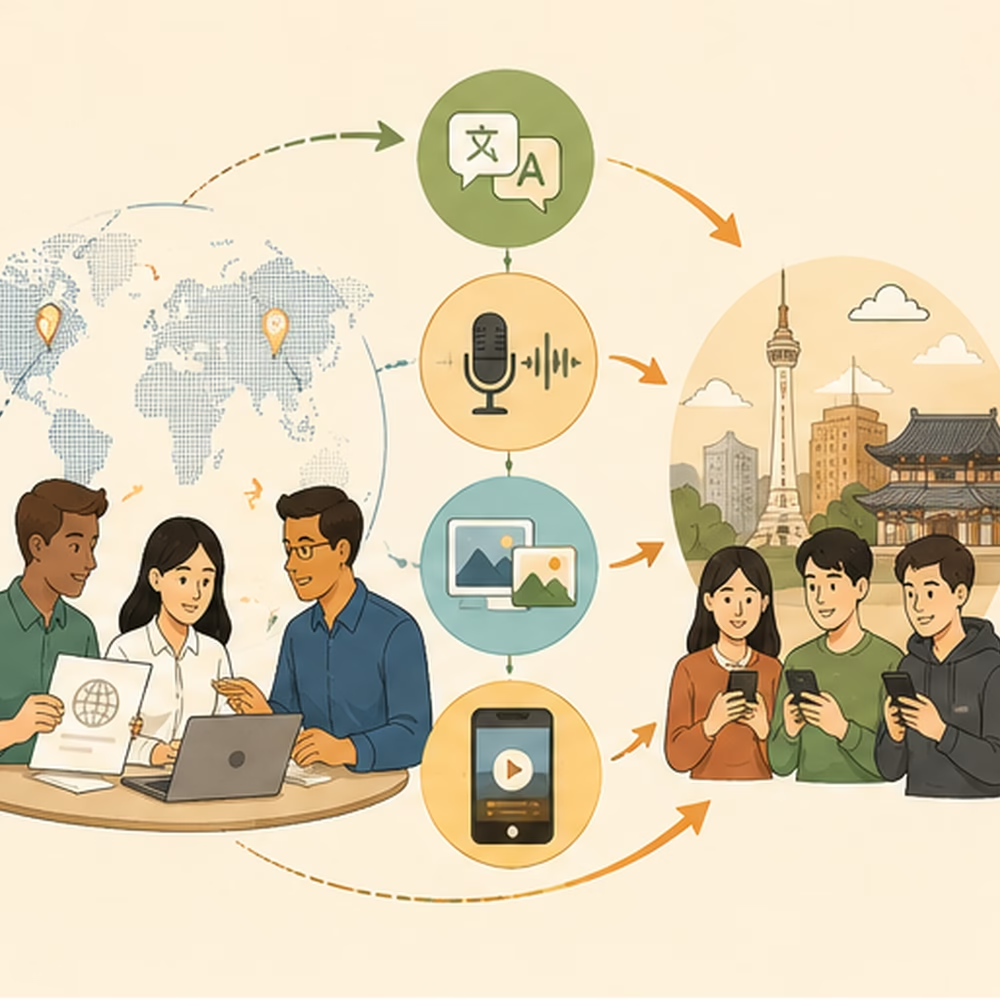
A Korean translation can be grammatically accurate and still feel unfamiliar, overly promotional, or disconnected from the people it is meant to reach. Cultural adaptation for Korean audiences means reviewing not only the words, but also the tone, message, examples, visuals, platform, and final delivery of the content.
From Korean voice-over scripts to UGC videos and marketing copy, I have repeatedly seen that the point where a translation sounds correct is not always the point where it starts sounding natural. This guide explains what global teams should review before launching content in Korea.

What Does Cultural Adaptation Mean for Korean Audiences?
Cultural adaptation is the process of adjusting content so that people in another market can understand, interpret, and respond to it in the intended way.
That makes it broader than translating words from one language to another. It can involve changing the tone, examples, information order, visual setting, speaker relationship, call to action, or even the content format itself.
Research on cross-cultural adaptation has emphasized that adaptation depends on more than language knowledge. Communication competence, interaction with people in the local environment, and exposure to local media all influence how effectively people operate within another culture.[1]
For global brands, the same principle applies to content. A message needs to function within the communication environment of the Korean market, not simply exist in the Korean language.
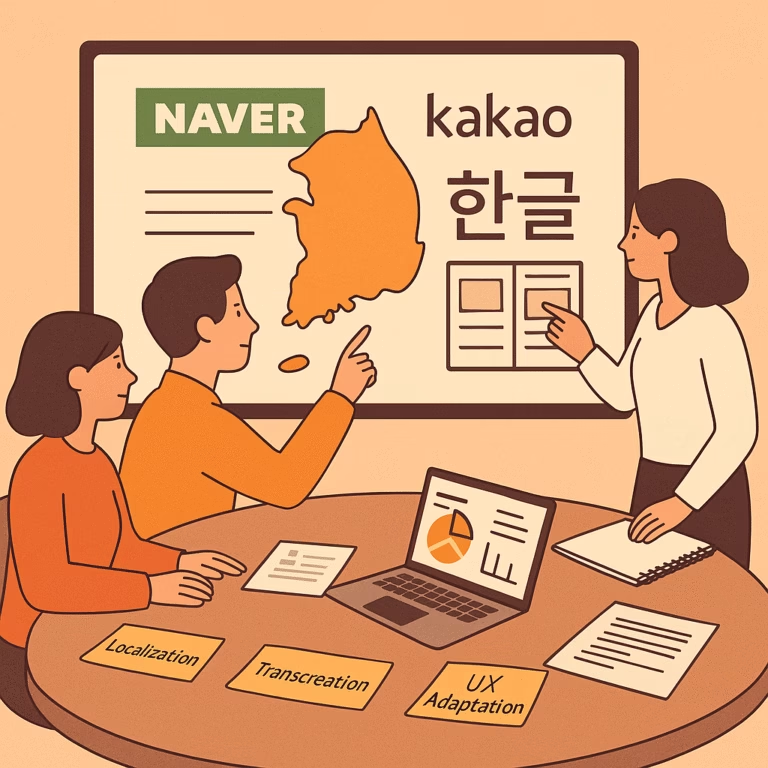
Translation, localization, transcreation, and cultural adaptation
These terms overlap, but they do not describe exactly the same work.
| Process | Main purpose | Simple example |
|---|---|---|
| Translation | Transfer meaning into Korean | Translating product instructions |
| Localization | Adapt language and market-specific elements | Changing currency, dates, UI, and terminology |
| Transcreation | Recreate the emotional or persuasive effect | Rewriting an advertising slogan |
| Cultural adaptation | Align the full communication experience with local expectations | Adjusting the message, tone, examples, visuals, format, and CTA |
Cultural adaptation does not replace localization. It adds another layer of judgment.
A website may be technically localized because its buttons, prices, and interface are displayed correctly in Korean. But it may still need cultural adaptation if its tone, proof points, or page structure do not feel persuasive to the intended Korean audience.
Why Direct Translation Often Fails in Korea
Direct translation does not always fail because the translator chose the wrong words. It often fails because the original content was designed around a different audience, relationship, platform, and buying environment.
The words are correct, but the tone feels wrong
English marketing content often uses direct statements such as “Get started now,” “Transform your business,” or “Stop wasting time.” Those expressions may work in the original campaign, but direct Korean equivalents can feel forceful, exaggerated, or unnatural depending on the product and target audience.
A mobile game advertisement targeting younger users may use energetic and informal language. A B2B landing page targeting enterprise decision-makers will usually require a more measured and credible tone.
The issue is not whether Korean content should always be more formal. It is whether the level of formality matches the brand, speaker, audience, channel, and stage of the customer journey.
The message assumes a different customer mindset
A global page may lead with statements about innovation, disruption, or being the market leader. Those messages can remain useful in Korea, but they may need stronger supporting information, such as how the product is used, whether Korean support is available, what the implementation process looks like, and what measurable benefit the buyer can expect.
Cultural adaptation does not mean removing the original value proposition. It means deciding what information the Korean audience needs in order to believe it.
The content format does not match the channel
A long global brand story may work on a corporate website but perform poorly when reused as a Korean mobile advertisement, short-form UGC video, app onboarding screen, voice-over script with strict timing, or Naver-focused informational page.
The underlying message may stay the same, but its structure and delivery usually need to change.
Seven Elements to Adapt for Korean Audiences
The following framework can be used to review a website, campaign, video, app, or other customer-facing content before launch.
1. Audience and Communication Context
Before adapting the words, define who is speaking and who is listening.
“Korean audiences” should not be treated as one uniform group. A message for a procurement manager, university student, parent, gamer, and first-time app user will require different language and proof.
- Is the audience B2B or B2C?
- Are they familiar with the product category?
- Are they comparing providers or learning about the problem?
- Is the speaker a brand, expert, creator, employee, or customer?
- Is the audience expected to purchase immediately or gather information first?
The relationship between the speaker and audience affects the appropriate level of formality, detail, confidence, and emotional expression.
2. Core Message and Value Proposition
The original campaign may contain several benefits, but they may not have equal importance in Korea.
- What problem does this solve?
- Why should the customer trust the provider?
- Does it work in the Korean market?
- Is Korean-language support available?
- How difficult is it to begin?
- What happens after purchase?
- Is there a relevant local example?
A common mistake is to translate every benefit in the same order as the global source material. Cultural adaptation may require changing the information hierarchy while preserving the core brand message.
3. Language, Tone, and Formality
Korean allows speakers to express relationships and social distance through sentence endings, titles, honorifics, and vocabulary. Global teams should therefore decide on a consistent tone before producing large volumes of Korean content.
- Formal versus conversational style
- Use of honorifics
- Sentence length
- Technical terminology
- Loanwords versus Korean equivalents
- Commands versus suggestions
- Brand terminology
- Consistency across pages and channels
The most formal wording is not automatically the most professional. Excessively formal Korean can feel distant, bureaucratic, or outdated. Likewise, casual expressions can feel forced when they do not match the product or speaker.
In Korean voice-over projects, I often see scripts that are grammatically correct but become difficult to deliver naturally once spoken aloud. The Korean sentence may be longer than the original English line, contain too many modifiers, or place the key meaning too late in the sentence.
For spoken content, the script should also be reviewed for breath, pacing, timing, natural emphasis, sentence rhythm, and whether a real person would say it that way.
4. Cultural References and Examples
References that are obvious in the source market may not carry the same meaning in Korea. These can include humor, idioms, celebrities, school and workplace situations, family relationships, holidays, sports references, pricing examples, measurements, and everyday routines.
The first question should not be “How do we translate this reference?” The better question is: Does this reference help the Korean audience understand the message?
Sometimes it can remain with a short explanation. Sometimes it should be replaced with a local equivalent. Sometimes the entire example should be removed.
Avoid superficial cultural adaptation
Adding traditional architecture, Korean food, or Seoul landmarks does not automatically make a campaign culturally relevant. Those elements may be appropriate when they are connected to the message. When they are added without a reason, the campaign can feel generic or stereotypical.
Cultural adaptation should start with audience understanding, not decorative symbols.
5. Visuals and Storytelling
Images communicate assumptions about the customer before the audience reads the copy.
- Who appears in the content?
- Does the setting feel relevant?
- Are the devices and environments believable?
- Does the story reflect how the product would actually be used?
- Are emotional expressions appropriate for the content type?
- Does the visual imply an unrealistic customer experience?
- Does the visual depend on text that has not been localized?
A global campaign does not necessarily need to replace every visual with a Korean model or location. The decision should depend on whether the image is product-focused, aspirational, instructional, testimonial-based, lifestyle-oriented, or strongly connected to a specific cultural situation.
6. Platform and Content Format
The same message should not automatically be reused across every Korean channel. A website, search advertisement, UGC video, app screen, and voice-over each impose different constraints.
Website and landing page
- Information hierarchy
- Headline clarity
- Trust signals
- Korean customer questions
- CTA strength
- Mobile readability
- Local contact and support information
Explore Korean localization services.
Paid ads and social content
- How quickly the benefit appears
- Whether the hook sounds natural
- Platform-specific length
- Visual speed and pacing
- Whether the CTA matches the buying stage
- Whether the content feels like an advertisement or a useful recommendation
Korean UGC
A global UGC script often becomes unnatural when every product feature is translated into spoken Korean. Natural Korean UGC needs a believable situation, a clear reason for mentioning the product, and language that sounds like something the creator would actually say.
In my work as a Korean UGC creator, this is one of the most important differences between translation and adaptation. The script must preserve the marketing point without making the speaker sound as though they are reading a brochure.
See Korean UGC production options.
Video subtitles and voice-over
- Reading speed
- Subtitle length
- Voice-over timing
- Lip-sync requirements
- Tone of the speaker
- Pronunciation of brand and technical terms
- Whether visual information makes part of the script unnecessary
Apps and onboarding
- Button length
- Navigation clarity
- Error messages
- Permission requests
- Customer support language
- Whether users understand the next action
- Consistency between the app, store listing, and campaign
7. Native Review and User Testing
Cultural adaptation should not rely entirely on assumptions made before launch.
- Language review: Is the Korean accurate and consistent?
- Cultural review: Do the message, references, and examples make sense for the intended audience?
- Brand review: Does the adapted content still sound like the same company?
- Format review: Does the content work inside the actual webpage, video, app, or advertisement?
- Spoken-language review: Can a creator or voice actor deliver the script naturally?
- Target-user feedback: Do intended users understand the benefit and next action?
- Post-launch review: Are users responding as expected?
Cross-cultural content research highlights the value of learning local language patterns and interacting with local communities.[2] Netflix’s Korean expansion has also involved local production infrastructure and collaboration with Korean creative partners, illustrating how local participation can be built into a broader global strategy.[3]
The useful lesson for smaller brands is not that they need the resources of a global streaming company. It is that cultural adaptation should be treated as a process of review and adjustment rather than a one-time translation task.
Cultural Adaptation Examples by Content Type
The following simplified examples illustrate common adaptation decisions. They do not describe specific client projects.
Marketing headline
Direct approach
Change the way you work forever.
Possible adaptation direction
업무 과정을 더 간단하고 효율적으로 관리해 보세요.
The adapted version is less dramatic but communicates a clearer and more believable benefit. The best final wording would still depend on the product and target audience.
Landing page CTA
A direct translation such as 지금 구매하세요 may be appropriate for a low-risk consumer product. For a complex service or B2B solution, another action may fit the customer journey better:
- 서비스 자세히 알아보기
- 도입 방법 확인하기
- 상담 요청하기
- 데모 신청하기
- 프로젝트 문의하기
Cultural adaptation includes selecting the right action, not merely translating the original button.
UGC script
Directly translated structure: List Feature A, Feature B, and Feature C, then ask the viewer to download the product.
Adapted structure:
- Begin with a recognizable problem.
- Show how the creator discovered or used the product.
- Focus on one or two meaningful features.
- End with a natural next action.
The adapted version is more likely to sound like creator content rather than a feature list.
Voice-over script
A short English sentence may contain several ideas because English can compress information differently. The Korean version may need to remove repeated information already visible on screen, split one sentence into two, place the main benefit earlier, shorten descriptive phrases, or adjust pauses to match the visuals.
This is why final-format review matters. A translation that looks fine in a spreadsheet may not work in a 15-second video.
A Practical Korean Cultural Adaptation Process
Step 1. Define the audience and objective
Document who the content is for, what they already know, what they should understand, what they should feel, and what they should do next.
Without this information, reviewers can correct Korean grammar but cannot make reliable adaptation decisions.
Step 2. Identify culturally sensitive elements
Mark the content that may require more than direct translation:
- Headlines and slogans
- Humor and emotional language
- Testimonials and social proof
- CTAs
- Visual scenarios
- Speaker relationships
- Cultural references
- Spoken scripts
Not every sentence requires transcreation. Focus resources on the areas that influence interpretation and action.
Step 3. Adapt the message before finalizing every word
- What should remain globally consistent?
- What needs local explanation?
- What should be rewritten?
- What should be removed?
- What additional information may Korean users need?
This reduces unnecessary rewriting later.
Step 4. Review with a native Korean specialist
A native review should cover more than spelling and grammar. The reviewer should understand the target audience, campaign objective, product, content format, brand tone, and where the content will appear.
A reviewer who only sees isolated sentences may miss the communication problem.
Step 5. Test the final format
- Read the completed landing page on mobile.
- Record the voice-over as a timing test.
- Place subtitles into the video.
- Ask a creator to read the UGC script aloud.
- Check whether Korean UI text fits the interface.
- Review the advertisement with its final visual.
Step 6. Collect feedback after launch
Useful signals may include questions from Korean users, drop-off points, search terms, ad comments, customer-service inquiries, CTA performance, creator feedback, and confusing product terminology.
A low response does not automatically mean that the culture was misunderstood. It may also reflect the offer, channel, targeting, or creative quality. Cultural adaptation should be evaluated as one part of the entire customer experience.
Korean Cultural Adaptation Checklist
Use this checklist before launching Korean-facing content.
Audience
- Is the target audience clearly defined?
- Is the content appropriate for their level of knowledge?
- Does the relationship between the speaker and audience feel clear?
Message
- Is the primary benefit relevant to the Korean audience?
- Is the most important information presented early enough?
- Are global claims supported with useful details?
Language
- Is the level of formality consistent?
- Does the Korean sound natural rather than translated?
- Are technical terms and brand terms used consistently?
- Are sentences easy to understand on the intended platform?
Cultural context
- Do examples and references make sense in Korea?
- Have irrelevant jokes or idioms been adapted?
- Does the content avoid cultural stereotypes?
- Are prices, units, dates, and local details correct?
Visuals
- Do the people and settings support the message?
- Does the content feel relevant without relying on superficial Korean symbols?
- Has all visible text been localized?
- Do the visuals create realistic expectations?
Format
- Does the Korean text fit the webpage, app, or video?
- Can spoken lines be delivered naturally?
- Are subtitles readable?
- Does the CTA match the customer journey?
Review
- Has the content received native language review?
- Has it received cultural and brand review?
- Has the final format been tested?
- Is there a plan for collecting feedback after launch?
Does Every Part of the Content Need to Be Changed?
No. Cultural adaptation does not mean turning a global company into a Korean-looking brand.
Elements that will often remain consistent:
- Core brand values
- Product functionality
- Technical facts
- Brand design system
- Central campaign concept
- Legal information
- Global visual identity
Elements more likely to require adjustment:
- Tone
- Information order
- Cultural assumptions
- Examples
- Spoken language
- CTA wording
- Testimonials
- Platform-specific format
The goal is not maximum change. The goal is appropriate change.
When Should You Work With a Korean Localization Specialist?
A native cultural review is especially valuable when the content:
- Represents the brand publicly
- Will receive paid traffic
- Will remain online for a long time
- Includes a slogan or major campaign message
- Uses humor or emotional storytelling
- Contains Korean voice-over
- Includes creator or testimonial content
- Introduces a new product category
- Targets a specialized B2B audience
- Is part of the brand’s first launch in Korea
The earlier a reviewer becomes involved, the easier it is to correct structural problems. Reviewing a completed campaign after every asset has been produced is still possible, but it may lead to unnecessary rewriting, re-recording, or editing.
Final Thoughts
Cultural adaptation for Korean audiences is not about making every global campaign look traditionally or visibly Korean. It is about making the content easier for Korean customers to understand, trust, and act on.
Translation answers the question, “What do these words mean in Korean?” Cultural adaptation asks a broader question: “Will this message work as intended when a Korean customer sees, hears, or interacts with it?”
That difference matters across websites, apps, advertisements, UGC, and voice-over.
Need a Native Korean Review Before Launch?
Already have an English source, Korean translation, or final creative? Share the content type, target audience, and current production stage in the form below.
I’ll review the details and suggest whether translation, transcreation, cultural adaptation, voice-over, or Korean UGC support would be the most practical next step.
You do not need a finished brief. A source file, draft, reference link, or short project description is enough to begin.