
Your English ad is fifteen seconds long. The Korean voice track finishes after the product demonstration has already ended, while the English headline remains above Korean subtitles. Asking the editor to speed up the recording may fit the file, but it does not fix the message.
Video ad localization needs decisions at the shot level: what the viewer sees, what they hear, what they can read, and what they are asked to do next. For a Korea launch, start by matching those decisions rather than commissioning a translation of the transcript alone.
The practical output is a repair sheet that lets a Korean writer, voice artist, and editor work against the same picture. Here is how to build it, with an illustrative Korean script you can adapt to your own product.
Where does video ad localization actually break?
Watch the existing cut without reading its script. Pause wherever an action, a product claim, or a new instruction appears. Those moments are your anchors. A sentence belongs beside the action it explains, not simply wherever there is spare space in the audio track.
Then watch with the sound off. If the only readable benefit is English, new Korean narration will not solve that version. If the product interface is still English because the Korean product is not available, record that limitation; do not invent Korean interface labels and make the advertised experience look different from the actual product.
Separate editable graphics from text embedded in footage. A title layer can be rewritten and reflowed. A label inside a screen recording may require a fresh capture, an approved overlay, or a different shot. These are different tasks and should not arrive at the editor as one vague request to "translate everything."
Build a shot-by-shot repair sheet
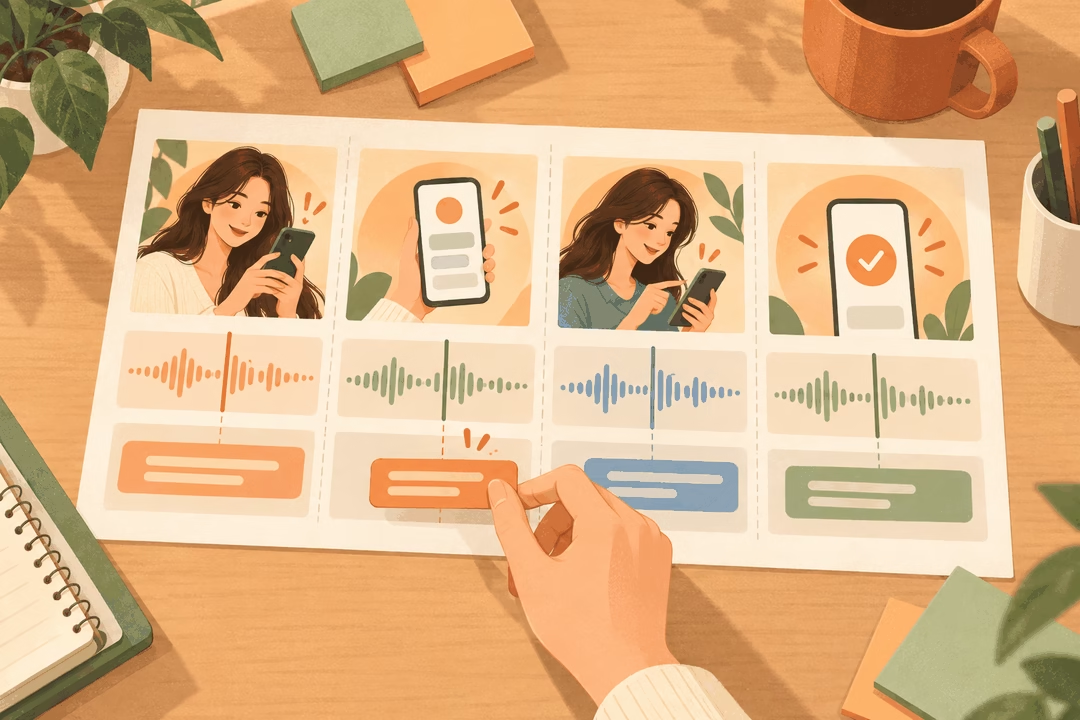
Use one row per meaningful shot, not one row per sentence. Six fields are enough to start:
- Time window: where the shot starts and ends in the current edit.
- Visible proof: the real product action or visual that supports the message.
- Korean spoken line: the approved message to read against that shot.
- Screen treatment: the headline, subtitle, interface, or graphic change required.
- Constraint: a fixed cut, unresolved product fact, unreadable text, or audio issue.
- Next edit: the specific change and who needs to approve it.
Mark whether the picture can move. If a product tap has to land at a particular moment, revise the line around it. If the shot is simply supporting footage, extending or replacing it may be cleaner than compressing a useful explanation.
The sheet is a coordination tool, not proof that the Korean script fits. Record a temporary read and play it over the cut before approving a final voice recording. Character counts do not measure spoken duration, and English word counts cannot tell you how a Korean line will sound.
Repair a fifteen-second SaaS ad before recording
Educational demonstration, not a client case: imagine a team-knowledge app with an approved Korean interface. Its sample video shows repeated questions, a searchable answer library, a saved answer, and a product-tour destination. The timing windows below are planning examples, not measured voice takes or performance results.
Opening shot, 0–3 seconds: name the visible problem
English concept: "Still answering the same question?"
Korean spoken direction: "또 같은 질문을 받고 있나요?" — "Are you getting the same question again?"
Show the repeated question while the line plays. The Korean sentence ending creates a polite, conversational question. It is a tone choice for this example, not a rule that all Korean advertising must sound soft. Keep an accompanying headline short; the subtitle carries the spoken sentence.
Product demonstration, 3–8 seconds: say what the action proves
English concept: "Put your team’s answers in one place."
Korean spoken direction: "팀의 답변을 한곳에 모으세요." — "Gather your team’s answers in one place."
Show an answer being saved into the library. Do not add a claim about automatic replies if the footage and approved product facts show only storage and search. Use the same Korean feature name on screen, in the script, and on the destination page.
Search result, 8–12 seconds: leave room for the evidence
Korean spoken direction: "필요할 때 바로 찾아보세요." — "Find it when you need it."
Let the search action finish before moving to the closing card. If the temporary read obscures the visual pause, test a shorter line or more picture time. Do not delete an essential qualification just to preserve the original duration.
Closing card, 12–15 seconds: promise the actual next step
Korean CTA direction: "사용 방법을 확인해 보세요." — "See how it works."
This version leads to a Korean product tour, so its CTA should not promise an immediate free trial. If the real destination is a signup flow instead, change the line and card together after confirming the actual offer. The repair sheet should contain that destination URL, not just the words "Korea landing page."
This demonstration is deliberately narrow: one problem, one product action, and one next step. For deeper wording decisions, see our guide to Korean transcreation for advertising. Here, the task is fitting the approved message to an actual edit.
What if the Korean recording still runs too long?
First identify what makes the line long. An English sentence may compress context that the Korean draft spells out. Remove repetition before removing meaning. A product name already visible on screen may not need to be repeated in every line, provided viewers can still understand the ad without relying on tiny text.
Read the revision in the intended delivery, including breaths and emphasis. A temporary neutral read is useful for planning but cannot guarantee that a more expressive final performance fits the same window. Give the Korean voice-over recording brief both the picture and the usable time for each cue.
If the message still does not fit naturally, change the edit or split the idea across shots. Treat aggressive speed changes as an option to review, not the automatic solution. A recording that technically ends on time can still make the product explanation hard to follow.
For a presenter speaking on camera, watch the mouth movement as well. Off-camera narration over a product shot is a different situation from replacing visible speech. Confirm the production approach and permitted use of the original performance before commissioning that change.
Make Korean subtitles and screen text do different jobs
Subtitles support the spoken message. A headline can highlight a short benefit or key term. Making both repeat the same long sentence can leave the product demonstration with no readable space.
Create subtitles from the approved final Korean wording and align them to the actual recording. Review line breaks at meaningful phrase boundaries. For this sample, keep "팀의 답변을" and "한곳에 모으세요" together as readable phrases rather than breaking a particle away from its noun to satisfy a rigid character target.
Check the exported placement, not only the editing canvas. TikTok’s official in-feed specifications explain that safe zones depend on dimensions, caption length, and additional formats. Use the current template for the placement; do not assume one fixed margin works for every vertical ad.
Before sending the cut onward, view it on a phone at normal playback speed. Can someone follow the action without pausing? Does the subtitle cover the search result? Is the CTA visible after the platform interface appears? Fix the specific obstruction rather than shrinking every Korean text element.
Review the cut and destination as one experience
Run three short passes with different questions. In the sound-on pass, check pronunciation, tone, and whether the voice explains the action at the right moment. In the sound-off pass, check what information survives through readable text and picture. In the click-through pass, follow the actual CTA to the correct language, product, and next step.
Write feedback as an edit instruction: "At the search shot, the result disappears before the Korean line finishes; hold the result longer." That is more actionable than "It does not feel Korean." Ask the reviewer to identify the timecode, the problem, and the proposed correction.
Keep the approved script, audio, subtitles, export, and destination associated with the same revision. If the CTA changes after recording, review the closing card and landing page again. A correct translation does not make an outdated offer correct.
Can you localize the existing video without a new shoot?
Often, yes, if the footage demonstrates the same available product and the message remains accurate. Editable text, separate audio, and useful supporting shots make adaptation easier. If the central visual shows a feature unavailable in Korea, a fresh capture or revised scene may be necessary. Decide from the actual footage, not from a blanket promise that every ad can be reused.
Start with one coherent Korean cut
Good video ad localization does not require replacing every visual or adding a cultural reference. Start with the mismatch that stops the explanation working: a late line, an unreadable caption, an uneditable headline, or a CTA that leads somewhere different.
Use the repair sheet to resolve that mismatch before producing more variants. Then test the finished ad against a defined campaign objective; language and production QA are not guarantees of conversion uplift.
If you need help connecting Korean copy, voice delivery, and production notes, explore Korean localization support. Share your existing cut, target placement, and the shot that is not working through the project form below so we can discuss the right scope.




Pingback: On-Screen Text Localization: Fix English in Korean Videos
Pingback: Video Localization vs Reshooting: Korean UGC Decisions