
Your Korean ad promises a starter set. The click lands on a page headed “Desk accessories,” showing a single tray. Both translations may be accurate. Together, they leave the visitor asking whether this is the set they just saw.
Ad message match is the continuity between what an ad leads someone to expect and what the destination actually provides. For a Korean campaign, review the ad and landing page as a pair—not as two translation jobs that happen to share a brand name.
You do not need to repeat every sentence. You do need to preserve the product, benefit, conditions, and next action. Here is a practical way to find a broken promise, repair the Korean wording, and hand off a version that can be checked before launch.
Where does ad message match break after localization?
Start with the thing the visitor believes they clicked for. A bundle is not a category. A downloadable sample is not a sales consultation. A feature shown on one plan is not necessarily available on every plan.
These distinctions can disappear when separate reviewers shorten an ad, polish a landing headline, and rename a button. Each edit can sound reasonable alone while changing the journey as a whole. An attractive Korean headline cannot fix a destination that lacks the advertised item.
Look beyond the written headline. Spoken narration, captions, product shots, and the closing card can each establish an expectation. If the video shows three pieces together, a page showing only one needs to explain the set clearly. If narration mentions a plan restriction, removing it from the page does not make the offer simpler; it makes it different.
General landing-page guidance such as Unbounce’s copywriting guide treats continuity with the preceding ad as part of writing the page. The extra localization task is to keep that continuity intact when the two assets are rewritten in another language.
Which promise should you carry into the Korean page?
Capture one actual ad and its actual destination before proposing new copy. Record the final URL after redirects, the advertised product or task, the main benefit, any necessary condition, and what clicking is supposed to do. Include the current Korean versions and their revision dates.
Do not start by copying the English slogan into the page. Establish the product facts first. Which items are included? Which feature can the customer use? Does the button open product details, deliver a file, start registration, or request contact from sales?
Then write a plain sentence a reviewer can verify: “This ad invites a visitor to view the contents of this starter set, which includes the tray and clips.” That sentence is the shared brief. Korean phrasing can change while those facts stay fixed.
If the ad makes a claim the product or page cannot support, correct the ad. Mirroring an unsupported promise on the destination creates consistency without accuracy.
How do you compare the ad and page without debating tone?
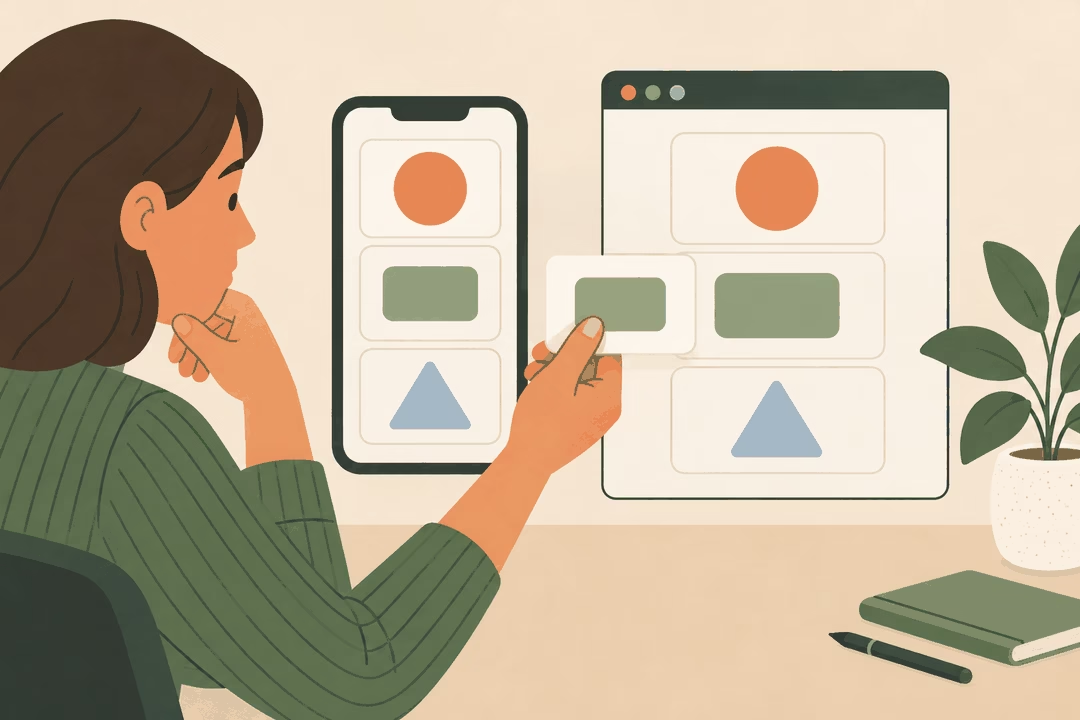
Use a promise matrix. It is a working record, not a conversion score. Keep the ad wording and page evidence in the same row so a reviewer can point to the exact difference.
Educational demonstration, not a client campaign: the following hypothetical starter set contains a tray and clips. Its destination shows the included items and lets visitors examine the set before deciding whether to buy.
| What the ad establishes | What must be clear on arrival | What to repair |
|---|---|---|
| A starter set containing a tray and clips | The same named set, with both included items | A generic “Desk accessories” hero showing only the tray |
| See the set’s contents | A visible contents section and an action leading to it | A button that opens an unrelated product category |
| The illustrated arrangement uses the included pieces | Images distinguish included pieces from background props | A styled photo that makes extra accessories appear included |
Add an owner and revision reference to each repair in your working file. The product owner confirms what is included; the Korean reviewer checks meaning; the page editor changes the destination. One person can fill all three roles, but the decisions should remain distinct.
Record uncertainty as a question. “Are clips included?” is actionable. Replacing it with an assumed answer just to finish the copy is not.
What would a meaning-preserving Korean repair look like?
For the demonstration, a proposed ad line is “트레이와 클립이 함께 들어 있는 스타터 세트”—“A starter set containing a tray and clips.” The destination headline could be “트레이·클립 스타터 세트”—“Tray-and-clips starter set.” The words differ, but the named product and included pieces remain recognizable.
Put the contents near the product introduction: “구성: 트레이 1개, 클립 4개”—“Contents: one tray and four clips.” Those quantities belong only to this fictional example; use the actual approved quantities in a real campaign.
If the ad invites visitors to inspect the contents, “세트 구성 보기”—“View set contents”—is a coherent action when the button reaches that section. Do not label the same button “구매 완료”—“Purchase complete”—or imply an action has happened when it has not.
This is not a rule that Korean audiences always prefer one tone or verb. The choice follows the verified destination. Ask the reviewer to explain the English meaning, why the product is identifiable, and what happens after the click.
For the separate question of adapting persuasive language, our Korean advertising transcreation guide covers copy adaptation. Here, the task is narrower: keep the ad’s factual promise connected to the page and its real action.
What if a condition is too long for the headline?
Keep the main promise readable, but do not erase the condition. Place a relevant qualification where the visitor can understand the offer before acting, and keep its meaning consistent across the ad and destination.
Consider a second fictional example: an ad demonstrates exporting a report to CSV, but the feature requires a Team plan. A shorter Korean headline can name the export task while nearby wording makes “Team 요금제에서 이용 가능”—“Available on the Team plan”—clear. The destination should identify that same plan and its actual next step.
Do not turn “available on the Team plan” into “available to everyone” to save space. Nor should a demonstration of one export format become a promise that every file type is supported. If the available creative space cannot carry the necessary meaning clearly, revise the creative or the offer presentation.
A back-translation helps a non-Korean stakeholder review meaning, but it does not verify product facts. Check the real plan, interface, and destination alongside the proposed words.
Does every ad need a separate landing page?
Not necessarily. Several ads can use one page when they lead to the same product, conditions, and next action. The page can support different reasons to care without pretending they are different offers.
Separate destinations become worth considering when the promises genuinely differ: a starter set versus one component, a downloadable example versus a consultation, or two products with different eligibility. First confirm whether a clear section or the right existing product page solves the mismatch. A new page is not automatically the simplest repair.
If your site changes content by URL parameter or visitor language, inspect the variant the ad actually opens. A translated headline on the default page says nothing about a redirect that sends Korean traffic elsewhere. Keep campaign attribution parameters when checking the destination, without placing private customer data in a URL.
How can you tell whether the repaired journey works?
Follow the delivered ad link on the intended device. Read the first screen, find the named item and relevant condition, then use the proposed action. Check what happens after it—not merely whether the button is clickable.
For production QA, keep a paired screenshot of the actual ad and destination, the approved Korean strings, and their revisions. After a page change, recheck active ads using that destination. A repaired headline can become stale when the offer changes.
For performance, compare attributable visits and the intended next-step event with a clearly documented baseline. If you run a controlled test, hold other important variables as steady as practical. Offer changes, traffic mix, loading problems, and tracking gaps can also affect results. A coherent journey is not proof of a conversion lift.
Google’s Search-campaign Quality Score documentation distinguishes ad relevance from landing-page experience and describes Quality Score as a diagnostic, not a KPI or auction input. That is a useful limit: neither a platform diagnostic nor this editorial review should replace your actual business outcomes.
Good ad message match removes the question “Did I arrive at the right place?” before asking someone to take another step. If your Korean ad and page were prepared separately, begin with one live pair and repair its specific promise. For Korean script and web-copy support, see our Korean localization services and share the ad, destination, and unresolved wording through the form below. Page implementation and other production work should be agreed in the project scope.