

Hire Korean localization expert for startups
Launching in Korea can look simple from the outside.
You translate your website, prepare a Korean landing page, run a few ads, and wait for users to respond. But for many startups, this is where the problem begins. The product may be strong, the design may look polished, and the global message may already work in other markets. Still, Korean users may not click, trust, sign up, or buy.
The reason is often not the product itself. It is the localization.
Korean localization is not just about changing English words into Korean. It is about adapting your message, tone, funnel, search presence, and trust signals to the way Korean users actually evaluate new products. For startups with limited time and budget, this matters even more. A weak first impression can make your Korea launch feel more expensive than it should be.
As a Korean marketer, voice talent, and localization partner working with global brands, I have seen how small wording choices can change how a product feels in Korean. This guide explains when to hire a Korean localization expert, what they should actually do, and how startups can avoid common market-entry mistakes.
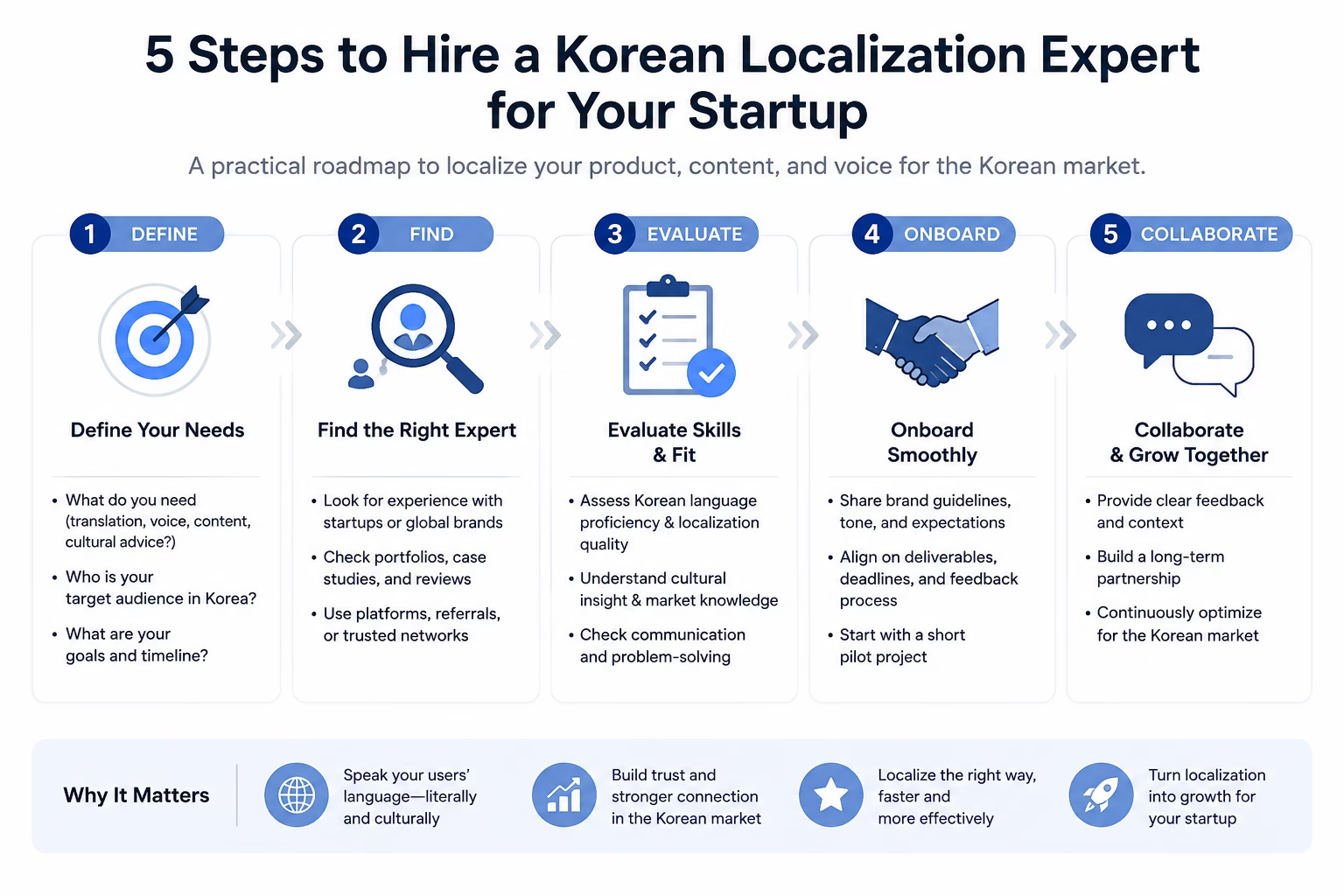
Why Startups Need More Than Korean Translation
Translation transfers meaning. Localization transfers intent.
That difference matters a lot in Korea. A sentence that sounds clear in English can feel too direct, too vague, too casual, or too sales-heavy when translated literally into Korean. Korean communication often requires careful decisions around formality, hierarchy, sentence endings, honorifics, and emotional distance. These are not just grammar issues. They affect trust.
For example, an English CTA like “Start now” may be technically easy to translate. But depending on the product, audience, and funnel stage, the Korean version may need to sound more helpful, more professional, or more reassuring. The right expression for a B2B SaaS landing page may not work for a consumer app. The right tone for a startup targeting Gen Z users may not work for a healthcare or finance product.
Korean localization also needs to consider how users validate information. Korean users often check search results, blogs, reviews, local payment options, social proof, and brand credibility before taking action. Website localization guides for Korea also emphasize that language, mobile behavior, and trust signals should be adapted together, not separately.
That is why startups should not treat Korean localization as a final polishing task. It should be part of the market-entry strategy.
The Common Mistake: Localizing the Product but Ignoring the Funnel
Many startups begin with the product interface.
They translate menus, buttons, onboarding screens, help pages, and app store descriptions. That is useful, but it is not enough. Korean users usually do not experience your product in isolation. They move through a wider funnel.
They may first see your ad. Then they visit your landing page. Then they search your brand on Naver or Google. Then they check whether the message feels trustworthy. Then they compare your product with local alternatives. Then they look at pricing, payment, reviews, and support.
If only the product UI is localized but the rest of the journey still feels foreign, users may hesitate.
This is especially important because Korea has its own search and platform behavior. Naver remains a major search environment, and its search results often include blogs, cafés, shopping, ads, news, and webpage blocks in a portal-like structure.
For startups, this means localization should not stop at “Korean text.” It should answer a bigger question:
Can a Korean user understand, trust, and act on this product without feeling like it was simply imported from another market?
What a Korean Localization Expert Actually Does
A Korean localization expert does more than correct grammar.
A good expert looks at your product from the perspective of a Korean user. They ask whether your value proposition is clear, whether your CTA sounds natural, whether your pricing explanation reduces hesitation, and whether your brand tone fits the local context.
For startups, this work usually includes four areas.
1. Website and Landing Page Localization
Your Korean landing page is often the first serious test of your market message.
A localization expert should not only translate the headline. They should check whether the headline answers the right user pain point. They should also review the subheadings, CTA, feature descriptions, proof points, FAQ, and contact flow.
For example, a startup may describe itself in English as “the fastest way to manage your workflow.” In Korean, that may sound too generic unless the message explains what type of workflow, who it is for, and what practical result the user can expect.
A good Korean landing page should make the product feel locally understandable within a few seconds.
2. Product and App Localization
Product localization includes UI copy, onboarding screens, button labels, error messages, push notifications, help center articles, and app store descriptions.
This is where direct translation can easily create friction. A button may be grammatically correct but emotionally awkward. An onboarding message may explain the feature but fail to guide the user. An error message may sound too cold or too unclear.
For consumer apps, the language may need to feel simple, friendly, and fast. For B2B software, it may need to feel precise, professional, and reliable.
The role of the localization expert is to make the product feel like it was built with Korean users in mind.
3. Korean SEO and Search Behavior Adaptation
Startups often underestimate Korean search behavior.
In many markets, Google-first SEO may be enough. In Korea, however, brands also need to think about Naver visibility, blog content, Korean keyword phrasing, and how users search before making decisions.
This matters because Korean users may not search for the same product category in the same way English-speaking users do. A literal keyword translation may have low search demand, weak intent, or an unnatural feel.
A Korean localization expert with marketing experience can help you avoid this mistake. They can review whether your Korean keywords match how local users actually describe the problem.
4. Marketing Copy and Transcreation
Marketing copy is where localization becomes especially important.
Ads, UGC scripts, social media captions, email campaigns, and brand slogans usually need transcreation, not translation. Transcreation keeps the original intent but rewrites the message so it feels natural and persuasive in the local market.
This is critical for startups because early campaigns often shape the first impression of the brand. If the Korean copy feels awkward, overly translated, or culturally flat, users may assume the product is not ready for Korea.
The goal is not to make the copy sound “more Korean” for its own sake. The goal is to make the message feel clear, credible, and worth acting on.
When Should Startups Hire a Korean Localization Expert?
The best time to hire a Korean localization expert is before you spend heavily on ads, PR, influencer campaigns, or full website translation.
If you localize too late, you may already have tested the wrong message.
For startups, Korean localization is especially useful in these moments:
| Situation | Why It Matters |
|---|---|
| Before launching a Korean landing page | Your first message needs to be clear and trustworthy |
| Before running paid ads in Korea | Poor copy can waste media budget |
| Before translating the full product | You need to validate the right tone and terminology first |
| Before contacting Korean partners or agencies | Localized materials improve credibility |
| When Korean traffic is coming but conversion is low | The issue may be message-market fit, not demand |
| When users ask many basic questions | Your Korean page may not be answering local concerns |
Startups do not always need to localize everything at once. In many cases, the better approach is to start small: localize the landing page, review the product message, test Korean ad copy, and then expand based on user response.
Freelancer vs Agency vs In-House: What Should Startups Choose?
There is no single right answer. The best option depends on your stage, budget, and launch speed.
Freelance Korean Localization Expert
A freelancer can be a good choice for early-stage startups that need speed, flexibility, and direct communication. This works well when you need a landing page review, app copy localization, Korean ad copy, UGC scripts, or market-entry messaging support.
The risk is that not every translator has marketing or startup experience. If your project requires positioning, funnel thinking, or Korean search insight, you should look beyond language ability.
Localization Agency
An agency can be useful for larger projects with multiple languages, legal requirements, large document volume, or complex QA processes.
However, agencies can be slower or more expensive for startups that only need a lean Korea-entry test.
In-House Korean Specialist
Hiring in-house can make sense if Korea is already a major market for your company. But for many startups, this is too early. Before building a Korean team, it is usually smarter to validate your message, funnel, and acquisition channels first.
For most startups entering Korea for the first time, the best starting point is often a hybrid approach: work with a Korean localization expert who understands both language and go-to-market execution.
What to Prepare Before Hiring a Korean Localization Expert
A localization expert can do better work when your brief is clear.
Before starting, prepare these materials:
| What to Prepare | Why It Helps |
|---|---|
| Product overview | Helps the expert understand what you actually offer |
| Target user profile | Korean tone changes depending on audience |
| Main competitors | Helps position your product locally |
| Existing landing page or app screens | Allows practical copy review |
| Brand tone guidelines | Helps preserve your global identity |
| Conversion goal | Clarifies whether the copy should drive signups, sales, demos, or downloads |
| Must-avoid claims | Prevents compliance or credibility issues |
| Korean market assumptions | Helps the expert correct weak assumptions early |
Do not just ask, “Can you translate this?”
A better brief is:
“We are a startup entering Korea. We need to adapt this landing page for Korean users, preserve our brand positioning, and make the CTA feel natural for local conversion.”
That one sentence gives the localization expert a much clearer role.
A Practical Korean Localization Roadmap for Startups
Startups should not localize everything at once unless they already have strong proof of demand.
A better roadmap is to localize in stages.
Phase 1: Message Review
Start with your core positioning.
Before translating the full website, check whether your value proposition makes sense in Korea. This includes your headline, product category, main benefit, CTA, and proof points.
At this stage, the goal is not perfection. The goal is to avoid launching with a message that Korean users misunderstand.
Phase 2: Landing Page Localization
Next, localize one focused Korean landing page.
This page should explain who the product is for, what problem it solves, why users should trust it, and what action they should take next. If your product is B2B, this may mean a demo request. If it is a consumer app, this may mean download or sign-up.
Phase 3: Search and Trust Layer
After the landing page, prepare the trust layer.
This can include Korean blog content, FAQ content, founder or brand story, comparison content, case studies, or Naver-oriented content.
This matters because Korean users may not convert immediately from one page. They may search again before deciding.
Phase 4: Ads, UGC, and Social Proof
Once the message is clear, you can expand into paid ads, UGC videos, influencer-style content, and social proof.
This is where Korean transcreation becomes useful. Your ad should not feel like a global campaign translated into Korean. It should feel like a Korean user is speaking to another Korean user.
Phase 5: Product UX and Support Content
Finally, expand localization into product UX, onboarding, customer support, help center content, and retention messages.
At this stage, the goal is consistency. Your ad, landing page, product, and support experience should all sound like the same brand.

How to Know If You Found the Right Korean Localization Expert
The right expert should not only say, “This translation is correct.”
They should be able to explain why one expression works better than another. They should understand the difference between literal accuracy and market fit. They should be comfortable discussing tone, CTA, user hesitation, platform behavior, and business goals.
Before hiring, ask these questions:
- Have you localized startup, SaaS, app, or digital product content before?
- Can you adapt marketing copy, not just translate it?
- Can you explain tone choices in English?
- Can you review Korean landing pages from a conversion perspective?
- Do you understand Korean search behavior or Naver content structure?
- Can you help us prioritize what to localize first?
A strong Korean localization expert should help you make decisions, not only deliver Korean text.
Final Checklist Before You Hire
Before you hire a Korean localization expert for your startup, check these points:
| Checklist | Why It Matters |
|---|---|
| Native Korean fluency | Essential for natural tone |
| Business or marketing understanding | Important for conversion-focused copy |
| Startup experience | Helps with speed and prioritization |
| Korean search awareness | Useful for SEO and Naver visibility |
| Ability to explain decisions | Helps your team learn the market |
| Portfolio or samples | Shows actual writing quality |
| Revision process | Prevents unclear expectations |
| Cultural judgment | Reduces awkward or risky messaging |
The goal is not to find the cheapest Korean translator. The goal is to find someone who can help your startup communicate clearly in a market where language, trust, and platform behavior are deeply connected.
FAQ: Hiring a Korean Localization Expert for Startups
How much does it cost to hire a Korean localization expert?
The cost depends on the project scope. A simple landing page review may cost much less than full website localization, app UX copy, ad copy, and SEO content planning. For startups, it is often better to start with a small but strategic scope instead of translating everything at once.
Can startups use AI translation first?
Yes, AI translation can help create a rough draft. But it should not be the final version for landing pages, ads, product messaging, or important user-facing copy. Korean tone, context, trust, and nuance still need human review, especially when conversion matters.
What should startups localize first for Korea?
Start with your core market-entry assets: landing page headline, product value proposition, CTA, pricing explanation, FAQ, and first ad copy. Once these are clear, expand into product UX, support content, SEO, UGC, and long-term brand content.
Is Korean localization different from Korean translation?
Yes. Korean translation focuses on meaning. Korean localization adapts the message for Korean users, platforms, cultural expectations, search behavior, and conversion context. For startups, localization is usually more valuable than translation alone.
Should I hire a Korean translator, a localization expert, or an agency?
If you only need accurate language transfer, a translator may be enough. If you need to adapt your landing page, app copy, ads, SEO direction, and market-entry message, a Korean localization expert is usually a better fit. If you have a large multilingual project or strict QA requirements, an agency may be useful.
Why is Korean SEO important for localization?
Korean users may search for your brand, product category, reviews, or alternatives before taking action. If your Korean keywords are translated literally from English, they may not match how local users actually search. Korean SEO helps your localized content become easier to discover and more relevant to local intent.
Conclusion
Hiring a Korean localization expert for startups is not just about making your product available in Korean.
It is about making your product understandable, trustworthy, and actionable for Korean users.
If you are entering Korea, your first priority should not be translating every page. It should be finding the right message, tone, and funnel for the local market. Start with your landing page, product positioning, Korean CTA, and trust signals. Then expand into search, ads, UGC, and product UX based on real response.
Korea can be a strong market for global startups, but users need to feel that your product was prepared for them, not simply translated for them.
Planning to launch in Korea?
We help global startups adapt their message, landing page, and marketing content for Korean users — with localization that connects language, culture, and market-entry strategy.
Contact us to discuss your Korean localization project