
Your Korean narration reaches the last sentence just as the ad cuts to its end card. The translation is accurate, but the only way to fit it seems to be a rushed read. Before asking the voice artist to go faster, check how much speaking time the edit actually allows.
Voice over script timing is not the same as matching a document’s word count to a video’s runtime. A thirty-second ad may reserve its opening for a sound effect and its ending for a silent product hold. The Korean script must fit the remaining windows while keeping the message, pronunciation, and intended tone intact.
Use the method below to find the overloaded line, shorten it without changing the offer, and test the revised Korean read before the final session. The worked examples are educational demonstrations, not recordings or client results.
Start voice over script timing with the usable window
Put the current cut beside the script. For each spoken section, mark the earliest acceptable start, the latest acceptable finish, and any pause the picture needs. Do not assume that all the time between two cuts belongs to the voice.
Imagine a thirty-second spot with two seconds of opening sound, twenty-five seconds available for narration, and three seconds of silent closing picture. Those numbers are an illustrative production choice, not a standard. Your edit may allocate them differently. The important distinction is that a thirty-second file does not automatically provide thirty seconds of speech.
Also distinguish total fit from local fit. A recording may end before the video does while its offer sentence still arrives after the offer card disappears. If one cue is crowded and another has spare time, decide whether the boundary can move. Do not borrow time from an unrelated scene without checking what the sentence will explain there.
For the broader picture, caption, and destination workflow, see our video ad localization guide for Korea. This guide focuses specifically on the spoken script’s time budget.
Use a Korean test read, not an English WPM target
The Voice Realm’s script-timing guide describes English words-per-minute estimates and checks them against spoken delivery. That distinction matters when a global team hands an English commercial to a Korean writer: an English estimate is not a Korean recording specification.
Korean spacing groups grammatical elements differently from English word boundaries. A short-looking product acronym can also become several spoken syllables once its approved pronunciation is written out. Neither the number of spaces nor a fixed percentage added to the English runtime tells you whether this particular Korean performance fits.
Prepare the exact spoken version first. Expand numbers and abbreviations into the forms the performer will use. Keep instructions such as a pause or an emphasis outside the spoken text. Then ask a Korean-speaking reader to record a scratch take in the intended tone, against the current cut.
Listen to the whole cue, including its final consonant and natural release. Write down the measured duration and the point where the meaning lands. A scratch read is a planning reference, not a guarantee that a final actor’s expressive take will have the same length. Validate again with the selected performance.
Record the mismatch in one line of feedback
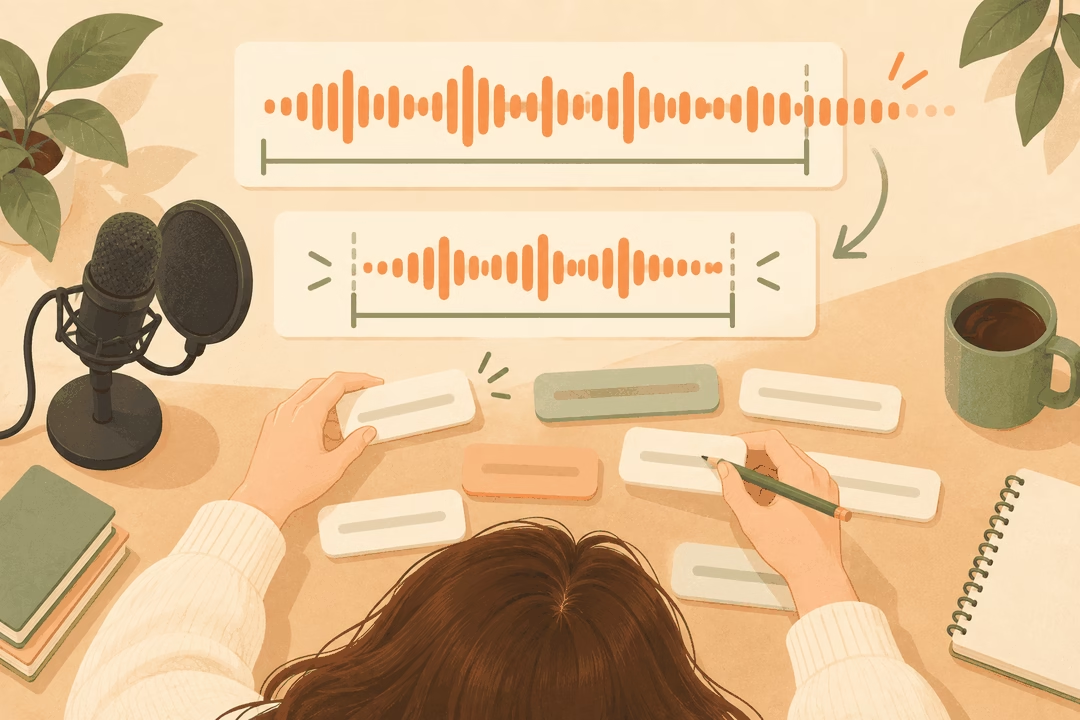
Create a compact timing record for each difficult cue. Keep these fields together:
- Cue and video revision: which passage and which cut were tested.
- Usable start and finish: the picture’s actual constraints, including intentional silence.
- Spoken Korean: the wording and approved pronunciation used in the test.
- Measured scratch-read duration: enter the result after recording, not a calculator’s prediction.
- Meaning that must survive: the action, claim, condition, or next step that cannot be lost.
- Proposed change: shorten wording, change delivery, extend the picture, or restructure the cue.
- Approval and retest: who approved the change and what the next recorded read showed.
For example, if an actual test gives a 5.8-second read in a 4.5-second usable window, the overrun is 1.3 seconds. These are hypothetical numbers demonstrating the calculation, not a measurement of the sample lines below. Record the difference before deciding how to fix it.
Useful feedback names the cue and the constraint: "The offer line runs past the closing card. Keep the eligibility condition, remove the repeated introduction, and record the revised line again." A request to "make it faster" leaves the performer to guess which information matters.
Shorten Korean wording without shortening the promise
The easiest words to cut are not always the safest words to cut. Start with duplicated context and cumbersome phrasing. Protect the part that tells viewers what they can actually do or receive.
Demonstration: make the action direct
Long draft: "지금부터 앱을 이용해서 매일 해야 하는 일을 보다 간편하게 관리할 수 있습니다."
Meaning: "From now on, you can use the app to manage your daily tasks more conveniently."
Revision: "앱으로 매일 할 일을 간편하게 관리하세요."
Meaning: "Manage your daily tasks conveniently with the app."
The revision removes the introductory "from now on" and replaces a long capability statement with a direct action. It is suitable only if the app and the task-management benefit are already established by the approved concept. If the ad needs to explain a different feature first, retain that information elsewhere rather than hiding it in the cut.
This is a wording demonstration, not a claim that the revised line fits a particular number of seconds. Record both versions in the intended delivery and compare their clarity as well as their duration.
Demonstration: keep the offer restriction
Long draft: "처음 가입하신 고객에 한해서 첫 주문 시에만 배송비를 무료로 제공해 드립니다."
Meaning: "Only newly registered customers receive free shipping on their first order."
Revision: "신규 고객은 첫 주문 배송비가 무료예요."
Meaning: "New customers get free shipping on their first order."
The shorter version still names both the eligible customer and the eligible order. "배송비 무료!" alone means "Free shipping!" and would remove those restrictions. Do not make that substitution merely because it is shorter.
The sample uses a friendly ending. A formal brand could prefer "신규 고객은 첫 주문 배송비가 무료입니다." Choose tone after confirming the message, then test the final version. The offer is fictional and must not be reused as a factual claim about a real product without approval.
Demonstration: clarify an abbreviation before timing it
Written draft: "AI가 보고서를 자동으로 정리합니다."
If the approved reading of AI is "에이아이," put that pronunciation in the recording notes. If the brand instead wants "인공지능," approve that choice before the test. The two forms may create different rhythm in this sentence; changing them after recording also changes the timing reference.
Do not replace a specific feature name with a broader term solely to save time. The listener still needs to recognize the product capability. For message-level rewriting beyond timing, our Korean transcreation guide covers adapting the advertising idea rather than translating each phrase literally.
Choose the fix that matches the cause
If the cue repeats what the preceding sentence already established, shorten the script. If it contains a necessary explanation with no useful picture time, consider extending a hold or restructuring the scene. If it fits comfortably but the delivery lacks energy, a different performance direction may be appropriate. These are different problems.
Voice actor Lance Blair’s commercial-script guide emphasizes leaving room for pauses and audible delivery. Use that principle without treating any suggested buffer as a universal Korean ad rule. Reserve the space your actual picture and message require.
After a wording change, review meaning before recording again. Check the product action, customer eligibility, quantities, dates, and CTA against the approved brief. A shorter sentence that changes the offer is not a successful timing fix.
If an editor proposes speeding up an existing take, compare the processed version with a fresh natural read. Listen for damaged consonants, an unnatural rhythm, and a final line that becomes difficult to follow. File duration alone is not the acceptance test. For visible on-camera speech, also establish whether mouth synchronization is required; that is a different production constraint from off-camera narration.
Retest the cue in the assembled ad
Place the scratch recording in the actual timeline and watch without stopping. Can the viewer hear the instruction and understand the picture before the next idea arrives? Does the last word finish cleanly? Is the closing action still clear?
VoiceProductions’ script-writing guidance recommends testing spoken wording and its relationship to the visuals. For your Korean version, turn that into a specific acceptance pass: review the approved line, the selected take, and the current cut together.
Keep timing and comprehension feedback separate. "Fits the window" describes runtime. "A Korean listener can follow the offer at normal playback" describes the communication test. A cue needs both. If a reviewer needs the script on screen to understand an essential phrase, revisit that phrase rather than calling the duration check complete.
Once the voice changes, update captions from the approved final wording and align them with the selected recording. Save the script version, pronunciation notes, take identifier, and video revision together. Otherwise, the next cutdown can accidentally inherit an older, longer line.
How many Korean words fit a thirty-second ad?
There is no reliable universal count for every Korean ad. The usable speaking window, pronunciation, pauses, message density, and delivery all affect the result. Use a count to spot unusually dense drafts within the same project if helpful, but approve the script from a Korean test read against the edit. Do not convert an English WPM target into a Korean guarantee.
Can a longer translation still fit the original video?
Sometimes. You may be able to remove repetition, choose more direct Korean wording, or adjust a flexible picture hold. If all the information and all the boundaries are fixed, the team must revisit the brief rather than demand an impossible natural read. Get the relevant approver’s decision before deleting a product condition or extending a fixed-duration placement.
Resolve the overloaded cue before the final session
Good voice over script timing begins with the real speaking window and ends with an understandable Korean performance in the finished cut. Measure the difficult cue, protect its essential meaning, make one justified revision, and retest it. A stopwatch helps identify the mismatch; it does not choose which promise your brand should keep.
If you need help with voice over script timing for a Korean recording, share the current video, the Korean draft, the intended tone, and the cue that runs long through the project form below. The Korean Voice Over can discuss script adaptation and recording scope around the actual production constraint.




Pingback: UGC Storyboard Template: A 20-Second Korean Product Ad