
Your product demo shows a report appearing on screen. The Korean narration is still explaining how to open the menu. Both tracks are correct in isolation, but together they make the product harder to follow.
Hiring a Korean voice actor for B2B product demo videos is not just a casting decision. You need a voice that explains the workflow clearly, a script that fits the actual interface, and a recording process that leaves room for product changes. This guide covers the brief, audition, synchronization, delivery, and final review that global SaaS and B2B teams should agree before recording.
What must the Korean demo help a buyer understand?
Choose one buyer task before choosing a voice. A demo for an operations manager evaluating a reporting workflow needs different explanations from a walkthrough for an administrator configuring access.
Write down the audience, starting problem, visible action, result, and next step. For example, a fictional reporting-tool demo might show how to select a data source, create a saved report, and share it with a colleague. That is a production example, not a claim about a client project.
TechSmith’s how-to video guide distinguishes a software demonstration, which shows a feature or workflow in action, from an explainer introducing why something matters. Keep that distinction in your brief: the narration should help viewers follow what the product is doing, not become a separate brand manifesto.
If you are still developing the introductory story rather than a screen-led workflow, our Korean explainer-video voice guide covers that broader format. For a product demo, prioritize the connection between the spoken instruction and the visible result.
What should a Korean voice actor for B2B product demo videos demonstrate?
A polished commercial reel can help you shortlist candidates, but it does not prove that a voice suits your product terminology. Request a short contextual audition and agree its scope with the talent before sending the full script.
Choose an excerpt containing an English feature name, an acronym or technical term, a transition between two actions, and one sentence explaining the buyer benefit. Provide the relevant screen recording. Ask for a clear, conversational reading, then one specific adjustment, such as less emphasis on the feature name or more space after the action.
- Clarity: Can a Korean reviewer understand the instruction without reading the script?
- Terminology: Are product names and approved acronyms pronounced consistently?
- Pacing: Does the voice leave room to watch the interface?
- Tone: Does the delivery sound like a capable guide rather than a sales announcement?
- Direction: Can the talent make a targeted adjustment without changing the whole performance?
Do not choose age, gender, or vocal depth as a substitute for audience fit. Let the Korean reviewer and product owner assess the same excerpt against the same brief.
Which script and screen details must be approved before recording?
Send the current product build or an approved screen capture, not only an English narration document. A voice actor cannot resolve a mismatch between an old script and a renamed button.
Prepare a compact terminology sheet with the displayed UI label, the approved spoken form, pronunciation guidance where needed, and a named approver. Include product names, integrations, acronyms, numbers, and recurring feature terms. If the interface remains in English, make sure the Korean instruction identifies the label viewers actually see.
Then review the Korean script for spoken clarity. Long English noun strings may need a different sentence shape, and a literal translation may place the important action too late. Resolve those choices before the recording session. Our Korean localization service is relevant when the brief includes script adaptation and terminology review as well as voice recording.
Keep claims within the approved product scope. Confirm plan availability, market availability, feature limitations, and any performance statements with the product team. The language reviewer checks the Korean wording; the product owner remains responsible for whether the claim is true.
Assign one person to consolidate feedback. Contradictory comments from sales, product, and regional teams should not arrive as separate recording instructions.
How do you synchronize Korean narration with the product screen?
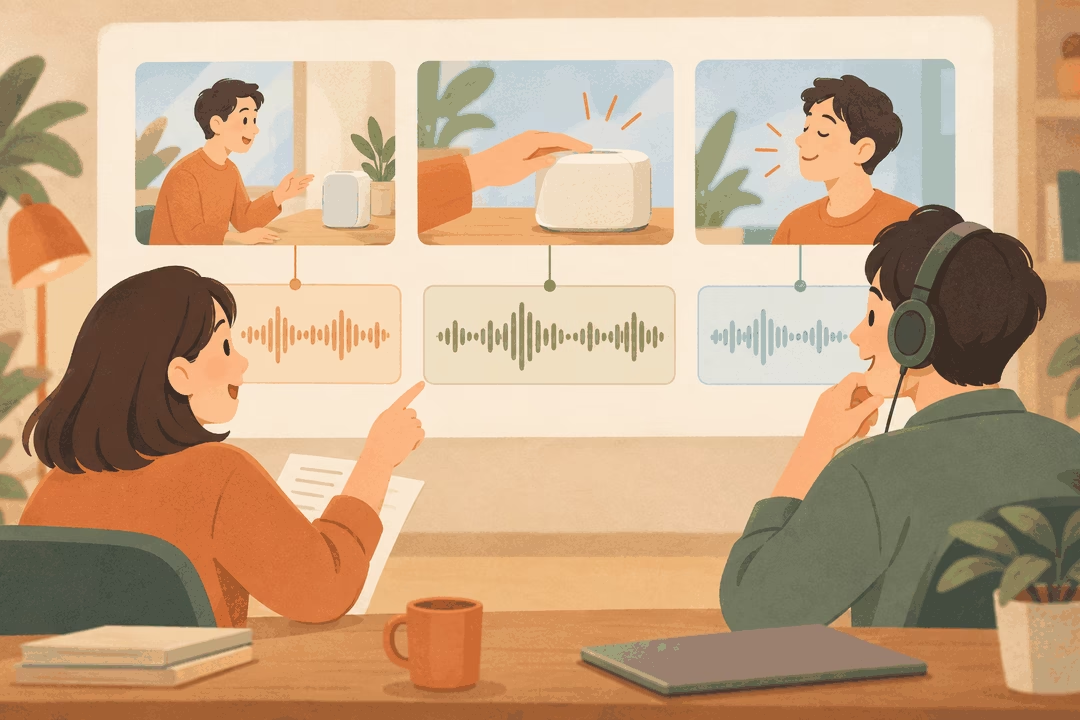
Build a scene-by-scene cue sheet. Each scene needs an identifier, a visual event, the approved Korean line, a timing window, and a note about whether the edit can change.
| Scene | Visible event | Narration job | Timing decision |
|---|---|---|---|
| Open | The relevant menu becomes visible | Name the action and the on-screen label | Leave time to locate the control |
| Configure | The setting changes | Explain the choice without adding a new feature claim | Pause for the visible selection |
| Result | The completed output appears | State what the viewer should notice | Hold the result long enough to inspect it |
This illustrative cue sheet is a starting point, not a fixed timing standard. Test the actual Korean read against the actual edit. Do not assume that an English word count, a universal speaking speed, or a percentage added to the English runtime will predict the Korean recording.
When a line does not fit, decide whether to shorten the Korean wording, extend the screen hold, or remove information that belongs elsewhere. Asking the actor to speed up should not be the default fix. A demonstration loses its purpose when viewers can hear the instruction but cannot follow the action.
Mark synchronization anchors such as a click, an opened panel, or a completed result. Also mark intentional silence. These notes are more useful to the editor than an instruction to “match the original exactly” when the Korean sentence structure differs.
What should the recording brief specify?
Give the talent and editor one agreed brief covering both performance and handoff:
- The intended viewer, viewing context, and single demo objective.
- The approved Korean script version and reference video version.
- Pronunciation references and approved UI terminology.
- Voice direction, with a short reference or specific descriptive notes.
- Scene boundaries, synchronization anchors, and flexible timing windows.
- The editor’s required file format, sample rate, bit depth, channel layout, and processing preferences.
- Whether delivery should include one continuous track, scene-separated files, selected alternate takes, or a mix.
- Who approves pronunciation, product meaning, and the assembled video.
Ask whether the editor wants clean narration without music and effects, or a processed voice track. “Broadcast quality” is not a substitute for an actual delivery specification. Confirm the format before the session so the files can enter the edit without an avoidable conversion or re-export.
How should you scope revisions and usage?
Separate a recording correction from a new product or script request. A misread approved line, a changed feature name, and a newly added scene are different reasons for a pickup recording. Agree how each is handled before production.
Record the included revision scope, feedback deadline, availability for later pickups, and any additional charges. Ask whether matching the original session’s sound is feasible for future updates. Do not assume that every change is included or that the same talent is indefinitely available.
Specify where the video will appear: a product website, sales presentations, customer onboarding, organic social, or paid advertising. Confirm the permitted usage, duration, territory, and versions with the provider. If you expect to reuse the voice track in cutdowns or another campaign, discuss that use rather than treating delivery of a file as unrestricted permission.
Agree separately on any synthetic-voice or voice-cloning use. Ordinary narration delivery should not be interpreted as permission to create a reusable digital replica.
For a useful quote comparison, ask each provider to separate script adaptation, casting, recording, synchronization, editing, pickups, and usage scope. A lower recording fee does not necessarily describe the same deliverable.
What belongs in the final Korean demo QA?
Review the assembled video, not just the audio file. Use the approved Korean script, terminology sheet, and product reference as the comparison set.
Meaning and terminology
Check every feature name, number, claim, and instruction. Confirm that the narration describes the exact action shown and does not turn an optional capability into an unconditional promise.
Screen timing
Watch the demo at normal speed without stopping. The action, spoken label, and visible result should be understandable together. Identify places where the narration runs ahead, lags behind, or competes with a dense screen.
Audio and captions
Listen for noise, clipped words, abrupt edits, inconsistent sound between pickups, and music masking the voice. Review the Korean captions against the final recording, then check them on a realistic mobile-sized player. A caption file based on an earlier script is not ready simply because the voice track was approved.
Product version and sign-off
Confirm that the final video matches the product build and market scope intended for launch. Record the approved script, video, and audio versions, plus the names of the product and Korean-language reviewers. Keep this record with the project so the next UI change has a clear starting point.
Can you keep English product names in a Korean demo?
Yes, when the English name is what users will see or what the brand requires. Decide the spoken form in advance and keep it consistent across narration, captions, and supporting materials. If a name is unfamiliar, add a concise Korean explanation of its function rather than inventing a translated button label that does not exist in the interface.
Do you need to translate the entire interface before recording?
Not necessarily. A Korean-narrated demo can show an English interface if the audience and release plan support that choice. Make the relationship between the spoken instruction and the visible label explicit. If the Korean interface is still changing, record only after the relevant labels are approved, or identify the affected scenes as planned pickups. Voice recording cannot remove uncertainty about what will ship.
What should you send when requesting a Korean product-demo quote?
Send the buyer audience, demo objective, current screen recording, approximate runtime, approved or draft script, product terminology, required formats, intended usage, review owners, and launch date. Identify whether the edit is flexible and whether future UI updates are expected.
The right Korean voice actor for B2B product demo videos helps viewers understand the product at the moment they see it working. Clear casting criteria matter, but so do approved terminology, screen-aware scripting, and a practical pickup plan.
To discuss a Korean voice actor for B2B product demo videos, use the form below to share one representative scene and your planned usage. The Korean Voice Over can review the recording brief and discuss the appropriate Korean narration and localization scope without requiring you to solve every production detail first.