
A chatbot can answer in Korean and still create more support work. The sentence may be grammatical, yet the answer can use the wrong level of politeness, quote a policy that does not apply in Korea, or send the customer back to an English-only handoff.
Korean chatbot localization for customer support is therefore not a translation pass on a finished bot. It is the work of aligning conversation tone, knowledge sources, product terms, interface copy, fallback behavior, and human escalation with the service you can actually deliver in Korea.
This guide is for global product and support teams planning a Korean-language chatbot. It explains what to localize, what to send a Korean specialist, how to test real conversations, and where human ownership must remain clear.
What does Korean chatbot localization change beyond translation?
A translated reply changes the language. A localized support journey also changes the context around that reply.
For Korea, review the greeting, suggested questions, input placeholder, error states, consent notices, knowledge articles, product terminology, dates, prices, operating hours, contact routes, and handoff messages. The bot should not sound Korean only until the customer needs help from a person.
Global Tech Council’s multilingual-chatbot guide identifies language routing, controlled terminology, preserved context, cultural adaptation, and native-speaker review as separate parts of the system. That is a useful procurement lesson: do not scope localization as a word count alone.
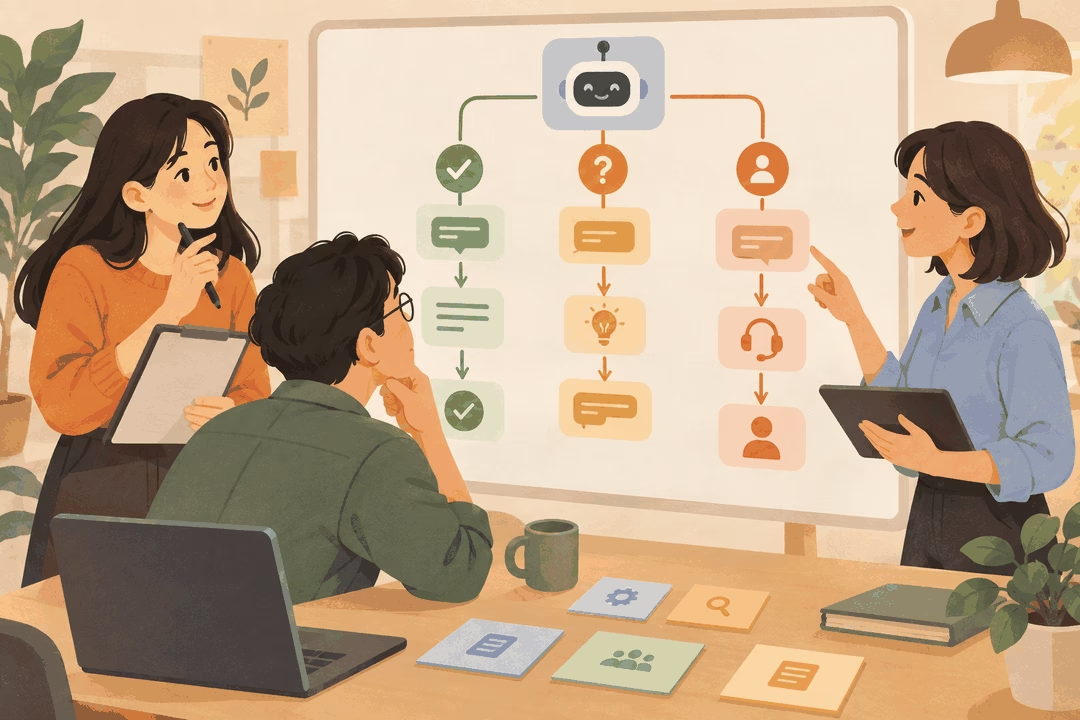
Start with one complete support journey. Follow the customer’s message from first contact to answer, clarification, error, and escalation. That exposes gaps that a spreadsheet of isolated replies will miss.
Which Korean tone should a support chatbot use?
Choose a default relationship with the user before translating scripts. Korean customer-service language often needs a polite conversational style, but “polite” is not one universal voice. A consumer lifestyle app may sound warmer than an enterprise security product. A payment failure should usually become more precise than a promotional welcome.
Give the specialist a short tone guide that answers:
- Who the user is and what they are trying to do.
- Whether the brand should feel warm, concise, formal, reassuring, or technical.
- Which Korean sentence style is the default for explanations.
- Which product names and English terms must remain unchanged.
- How the bot should apologize, refuse, ask for clarification, and admit uncertainty.
- Which claims or promises the bot must never improvise.
Consistency should follow function, not force every line into the same length or ending. A short button label, a troubleshooting instruction, and a privacy notice do different jobs.
Our Korean UX writing guide explains why action labels and recovery messages need product context. The same principle applies to a chatbot: wording cannot fix an unclear rule or a missing recovery path.
Should you localize the chatbot’s knowledge base or only its replies?
Separate universal product facts from Korea-specific facts before choosing an architecture.
Universal content may include how a feature works or where a setting is located. Korea-specific content may include prices, payment methods, delivery coverage, support hours, eligibility, privacy language, local contact routes, and terms that differ by market.
Alee’s chatbot localization guide describes three models: parallel localized content, a single source with translation at response time, and a hybrid. The hybrid is often practical: maintain reviewed Korean sources for market-specific or high-risk answers, while translating only content that is genuinely universal.
Whichever model you use, record the source of truth for each answer. A fluent Korean sentence is still wrong when it retrieves an English policy that does not apply in Korea. Add owner, market, effective date, and review date to important source documents so the support team can update them before the bot repeats stale information.
What should you send a Korean localization specialist?
Do not send only exported message strings. A useful handoff connects language to the support system.
Include:
- The top Korean user intents and real anonymized question patterns.
- Conversation maps for happy paths, clarification, failure, and escalation.
- The current knowledge sources and which ones are market-specific.
- Screenshots or a test environment for the widget and linked product flow.
- A terminology list with product names, UI labels, prohibited translations, and approved variants.
- Variables, character constraints, links, business hours, dates, and number formats.
- The expected language after handoff and the team that receives the conversation.
- Rules for sensitive information, authentication, refunds, eligibility, or other controlled topics.
- Named product, support, and Korean-language reviewers.
Also identify what remains unresolved. A localization specialist can suggest how to ask for clarification, but the product owner must define what the bot can do. The support owner must confirm the actual handoff promise. The appropriate internal team must approve policy and regulated language.
How should you test a Korean customer-support chatbot?
Test tasks, not screenshots. A Korean reviewer should complete representative conversations without being told what the bot is supposed to understand.
Build a compact test set across six areas:
Natural questions
Use complete questions, fragments, typos, product nicknames, and messages that mix Korean with English feature names. Short inputs may be ambiguous, so verify that the bot asks a useful question instead of guessing.
Product terminology
Check that the chatbot uses the same Korean labels as the product. A correct explanation with a button name the user cannot find is not a successful answer.
Market-specific facts
Ask about Korean prices, availability, payment, contact hours, policy exceptions, and dates. Confirm the answer against the approved source rather than judging only the sentence quality.
Conversation memory
Change the wording or language mid-conversation and confirm that the bot preserves the user’s issue. Repeating questions after every language switch makes the service feel disconnected.
Uncertainty and recovery
Remove a fact from the knowledge source or ask an unsupported question. The bot should acknowledge the limit, collect only necessary details, and offer the correct next step.
Human handoff
Confirm that the transcript, language, issue, and relevant account state reach the right team. Test the message shown outside support hours and verify that its response-time promise is true.
SEMOPL’s comparison of Korean-speaking support agents is a useful reminder that platform support for Korean is not uniform. Verify the exact product capability and version you plan to deploy instead of assuming that a Korean interface means Korean generative replies are supported.
What metrics reveal a localization problem?
Break results out by language and intent. Overall chatbot performance can hide a weak Korean experience.
Track resolution rate, fallback rate, repeated questions, human-handoff rate, handoff completion, and customer feedback for Korean conversations. Review a sample of resolved conversations too; containment is not success if the customer gave up after receiving a polished but irrelevant answer.
Label defects by cause: missing knowledge, wrong market source, intent failure, terminology, unnatural Korean, broken link, misleading UI copy, or failed escalation. This makes ownership clear and shows whether the next fix belongs to content, product, support operations, or the model configuration.
Who should own Korean chatbot updates after launch?
Treat localization as an operating process, not a one-time delivery. Assign an owner for product facts, an owner for support policy, and an owner for Korean language quality. Decide which changes trigger re-review: pricing, eligibility, product UI, support hours, consent wording, new intents, and major model or platform updates.
Keep a simple change log with the source changed, affected conversations, Korean reviewer, approval date, and test result. This is more useful than discovering months later that the English help center changed while the Korean bot kept answering from an old translation.
The Korean localization service can support terminology, tone, conversation copy, and implementation notes. The exact scope should match the platform, access available, and review responsibilities inside your team.
Can machine translation handle Korean chatbot localization?
Machine translation can help with low-risk drafts and universal content, but it does not decide whether the underlying policy applies in Korea, which Korean register fits the brand, or when the bot must hand off. Use it inside a controlled workflow with approved sources, terminology rules, native review, and scenario testing.
Do you need a separate chatbot for Korean?
Not necessarily. A multilingual bot can serve Korean users if it routes to the right sources, applies Korean-specific conversation rules, and preserves context. A separate bot may be easier when Korea has different products, policies, teams, or compliance requirements. Choose based on operational differences, not language alone.
What should you send when requesting a quote?
Send the platform, target users, top support intents, current languages, sample conversation flows, knowledge sources, Korean market differences, handoff process, review owners, required deliverables, and launch timeline. State whether you need translation, conversation rewriting, terminology, QA, or ongoing updates.
Korean chatbot localization for customer support should make the service accurate, understandable, and recoverable from the first message through human handoff. If your team needs help shaping Korean conversation copy and a review-ready localization scope, use the form below to share one representative support journey and your planned launch timeline.