
Your English website may look perfect — but in Korea, it might still struggle to reach your audience.
That’s because while many Koreans use Google, a huge portion still rely on Naver — two platforms that rank and display content very differently.
Localization, therefore, isn’t just about translating your content into Korean.
A truly localized website doesn’t just sound Korean; it feels Korean — from tone and phrasing to fonts, address formats, and payment flow.
In this article, you’ll learn how a proper Korean localization service for websites helps you connect with Korean users, improve visibility across both Google and Naver, and increase conversions — without rebuilding your entire site from scratch.
Why You Need Korean Website Localization
Korean audiences expect more than translated text.
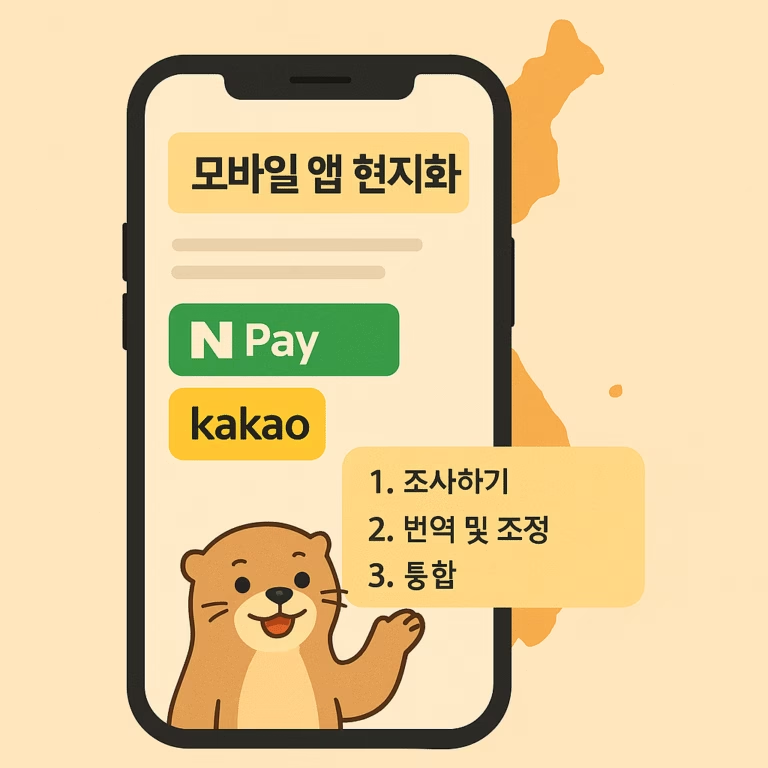
They expect a local experience — polite language, native layout, and trust-building cues such as KakaoTalk contact buttons or KRW pricing.
Even global brands like Airbnb and Notion customized their Korean sites for tone, cultural context, and usability, not just language.
- Local tone: Korean copy avoids direct commands (“Buy now”) and uses softer tones “Why don’t you try it now?”).
- Visual layout: Shorter lines, larger fonts, more vertical spacing for mobile readability.
- Cultural UX: Address fields, date formats, and navigation differ from Western sites.

What’s Included in a Korean Localization Service
A good localization partner handles both language and website structure.
1) Translation + Transcreation
We adapt your English copy to natural Korean expressions that match your brand’s tone — from marketing headlines to CTA buttons.
2) Naver SEO Optimization & Blog Strategy
In Korea, Naver and Google coexist — but they operate very differently.
Naver’s algorithm prioritizes blog content and native engagement, so even a perfectly localized website may not rank high on Naver.
That’s why many global brands run a separate Naver Blog as part of their localization strategy.
By publishing articles, case studies, and brand stories there, companies can build credibility and drive organic traffic more effectively than relying on website SEO alone.
Brands like Adobe Korea and Shopify Korea maintain official Naver Blogs to educate users, announce updates, and connect through keyword-rich local posts.
This hybrid approach — localized website + Naver blog — creates both discoverability and trust within the Korean ecosystem.
3) UI & UX Localization
We adjust line spacing, fonts, and address/payment fields so your forms and checkout pages work seamlessly for Korean users.
4) QA & Usability Testing
Before launch, we test your localized website on mobile and PC to ensure there are no broken texts, layout issues, or font mismatches.

The Step-by-Step Localization Process (Flexible by Needs)
This roadmap is a typical blueprint, and we adjust the order and scope based on your product, timeline, and tech stack.
That said, three stages are non-negotiable for quality: Keyword Research → Translation/Transcreation → QA.
- Audit & Keyword Research (mandatory)
Market and competitor scan, search-intent mapping, and a lightweight keyword map for core pages.
Defines tone, terminology, and page priorities. - Style Guide & Terminology
Korean tone-of-voice, honorific rules, glossary, UI string guide, and CTA patterns to ensure consistency. - Pilot Page Localization (mandatory: Translation/Transcreation)
Localize a few high-impact pages first (homepage, pricing, key landing pages).
Adjust layout and microcopy for Korean reading flow. - Full-Site Rollout
Apply the tested tone and style across your entire site — navigation labels, forms, address formats, and legal notices. - QA & Usability Testing (mandatory)
Cross-device/font/line-break checks, broken link fixes, and form validation for a polished launch. - Launch & Post-Launch Options (pick what you need)
- Search Console tracking: monitor queries and expand pages based on keyword data.
- Content add-ons: create FAQs, comparison pages, and case studies aligned with emerging queries.
- Naver footprint: run a companion Naver Blog for Naver-native traffic and engagement.
- A/B tests & UX trims: refine CTAs and mobile forms for conversion lift.
- Collaboration model: one-off delivery, ongoing monthly support, or long-term partnership — whatever fits your growth plan.
👉 Contact me today for a free consultation on Korean website localization and Naver SEO strategy.