If your app is entering Korea, translating the UI is not enough.
Korean users already live in a mobile-first environment with high expectations for polish, speed, and local relevance. That means even a technically correct app can feel foreign the moment the voice sounds awkward, robotic, or overly translated.
That is why a Korean dubbing service for mobile apps is not just a production add-on. It is part of localization quality, user trust, and conversion performance.
South Korea is one of the most mobile-centric markets in the world. Smartphone penetration reached 95.3% in 2024, smartphone dependence as a daily medium rose to 75.3%, and average smartphone screen time reached 2 hours and 6 minutes per day. OTT consumption is also heavily mobile, with 91.2% of OTT users watching on smartphones. In 2025, internet penetration reached 97.4%, while mobile connections were equivalent to 134% of the population. South Korea also recorded approximately $7.86 billion in app consumer spending in 2023.
For app teams, this means one thing. Korean users are not judging your product in a low-expectation market. They are comparing it against polished local apps every single day.
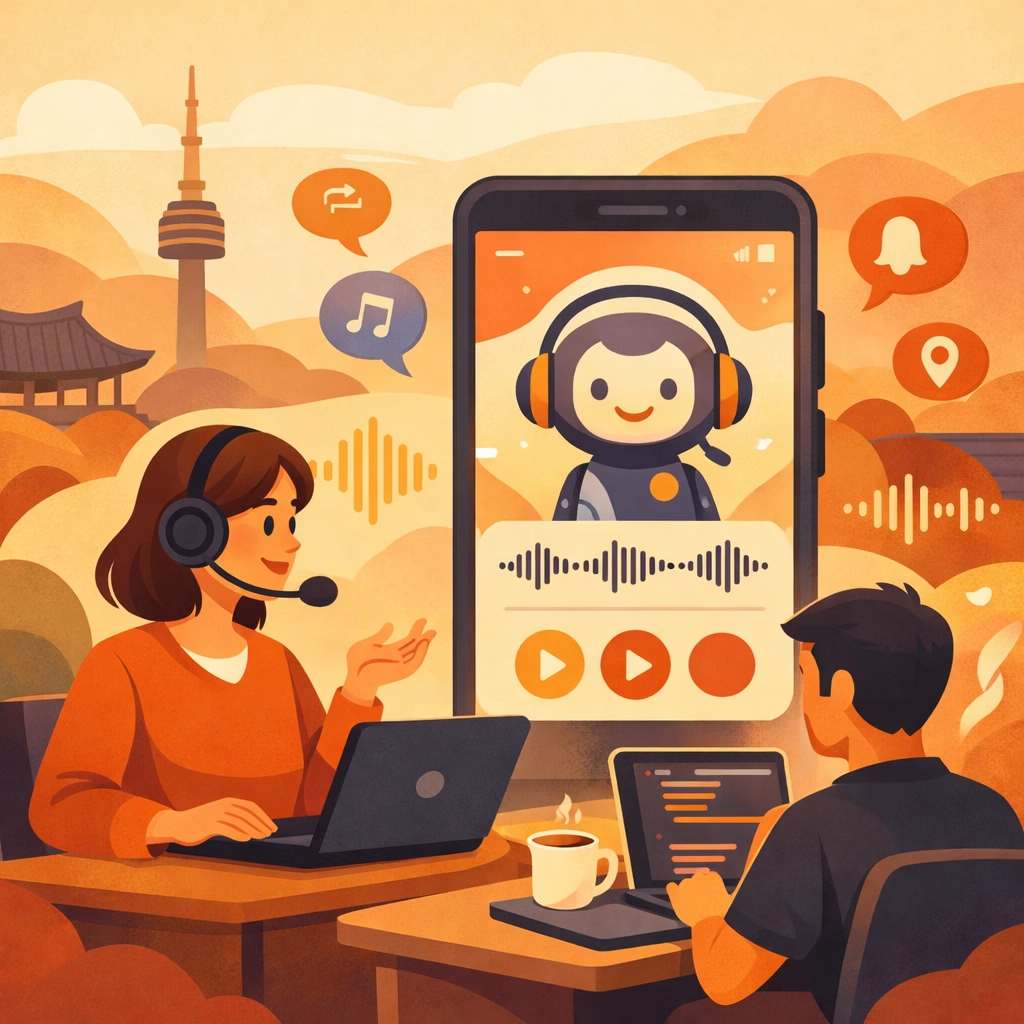
That is where voice becomes important. In Korea, voice is not simply “spoken translation.” It is often a signal of whether the service feels local, trustworthy, and complete.
A natural voice can strengthen guidance, reduce friction, and reinforce brand personality. An unnatural one can make the entire app feel imported, even if the rest of the product is strong.
What Is a Korean Dubbing Service for Mobile Apps?
A Korean dubbing service for mobile apps is the process of recording, adapting, and delivering Korean voice content for in-app use.
Unlike film dubbing or long-form narration, app dubbing usually involves short and structured voice assets. These may include onboarding prompts, tutorial narration, AI assistant replies, navigation guidance, reminder alerts, or spoken confirmations.
The key difference is that app dubbing is not only about voice recording. It also includes localization decisions about tone, politeness level, script adaptation, pacing, and how each line fits the interface.
In other words, the goal is not to read the English script in Korean. The goal is to make the app sound like it was designed for Korean users from the beginning.
This is especially important because spoken Korean exposes awkward phrasing much faster than on-screen text. A sentence can look acceptable in the UI, but once it is voiced, issues with literal translation, unnatural word order, or tone mismatch become obvious immediately.
Why Voice Localization Matters in the Korean App Market
Korean users are already surrounded by refined local platforms and strong mobile UX standards. That makes them highly sensitive to anything that feels unpolished.
If an app’s Korean voice sounds too literal, too stiff, or too synthetic, users may not consciously describe the problem as “bad localization.” Still, they often feel that the service is less trustworthy or less complete.
This matters even more in moments that affect retention and conversion. Voice plays a direct role in first impressions during onboarding, comprehension during tutorials, confidence during payment or security flows, and trust in AI-based interactions.
When those moments are delivered with natural Korean phrasing and the right tone, the product feels smoother and more credible. When they are not, users experience extra friction.
For global teams, this is the real business case for a Korean dubbing service. It helps protect product perception in a market where mobile usage is already mature and user expectations are high.
How Voice Is Used Inside Mobile Apps
In modern mobile apps, voice is often part of the interaction design itself rather than a decorative feature.
Google’s Material Sound guidance explains that sound should be functional, understandable, and aligned with brand identity. Android guidance also recommends co-designing visual, audio, and haptic feedback instead of treating sound as an afterthought. Google Material Sound and Android haptics principles both support this broader UX approach.
One of the clearest examples is the meditation and sleep category. Apps like Calm and Headspace rely on guided narration as a core part of the product value. In these products, the voice is not just carrying information. It is shaping the emotional experience.
Language learning apps use voice differently but just as critically. Duolingo’s speaking-skills approach shows how voice becomes part of the learning interaction itself, not just explanation. The user is listening, repeating, reacting, and judging the app through speech.
Navigation and mobility apps also depend heavily on voice. Korean users already treat spoken guidance as a normal part of everyday app use, which is why a global app with weak Korean voice prompts can feel unfinished. Coverage around NAVER Map voice-related public transit notifications illustrates how voice and alerts support convenience and multitasking.
AI assistants and conversational apps add another layer. The voice becomes the brand persona. Samsung’s documentation around customizing Bixby Voice shows how users increasingly expect natural, adjustable voice interaction. In these products, tone is not just usability. It is brand identity.
AI TTS vs Human Dubbing: When Each One Works
AI text-to-speech has improved significantly, and for some products it is the right operational choice.
It is fast, scalable, and especially useful when text changes frequently, when teams are testing prototypes, or when the main goal is to deliver information rather than emotion. Research such as the PLOS study on voice clones reflects how realistic synthetic voice is becoming.
But realistic is not the same as optimal for product experience.
Trust, nuance, sentence endings, emphasis, and emotional fit still matter in many app contexts. Research on trust in voice interfaces and studies comparing human and AI voice-over suggest that users respond differently when credibility, cognitive load, and persuasion are involved. You can review examples from the CHI trust study and the human vs. AI voice-over research.
In practice, AI voice is often good enough for internal testing, accessibility support, highly dynamic content, or low-risk informational prompts.
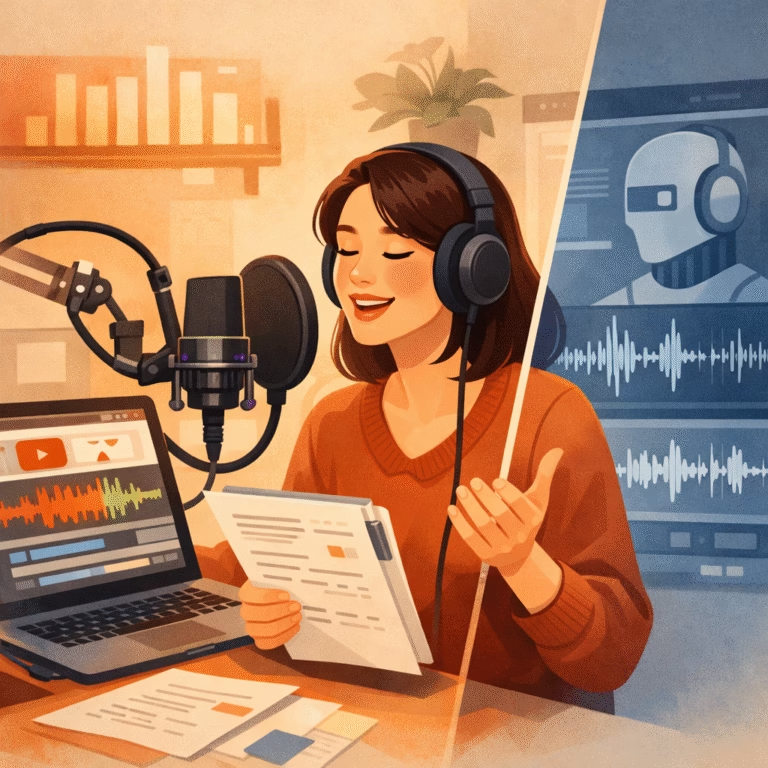
Human dubbing tends to perform better when the user experience depends on trust, brand impression, reassurance, or emotional tone. That includes onboarding, tutorials, meditation, coaching, payment or security guidance, navigation, and branded assistant experiences.
For many teams, the smartest decision is hybrid. Use AI where speed and scale matter most. Use professional Korean dubbing where user trust, clarity, or brand perception matter most.
Technical Considerations for Developers and Product Teams
This is where many generic voice-over pages fall short. Developers do not only need a nice recording. They need assets that are easy to integrate, optimize, manage, and update.
The first technical issue is format compatibility. Android officially documents supported containers and codecs in its supported media formats guide, while Apple’s audio documentation helps clarify playback and platform-specific considerations through Using Audio and its VoiceOver guidance.
For Korean app dubbing, it is often best to separate “master quality” delivery from “app-ready” delivery so your team can balance fidelity and performance.
The second issue is file size. Voice assets can quickly bloat installs and updates, especially when multiple languages are bundled together. Google’s own app size optimization guidance and Play Asset Delivery documentation are useful here.
If your app includes a large Korean voice package, it may be worth separating assets by language or downloading certain files only when needed.
The third issue is timing. Voice clips often need to align with onboarding flows, visual highlights, tutorial pacing, or user-triggered interactions. A technically correct translation may still fail if the Korean audio is too long, too abrupt, or poorly timed with the interface.
The fourth issue is content management. App dubbing often involves hundreds of short clips, so strong teams typically organize lines by key ID, maintain script versions by build, define re-recording triggers for updated lines, and run QA for length, volume, pronunciation, noise, and tonal consistency.
If you want your Korean dubbing workflow to be usable by both content and engineering teams, these implementation details should be discussed before recording starts.
Common Korean Localization Mistakes in Voice UX
One of the biggest mistakes global teams make is assuming that translated text can simply be read aloud. In Korean, sentence endings, politeness level, and phrasing strongly affect how the service feels.
A line can be grammatically correct and still sound cold, stiff, or strangely literal when voiced.
For example, direct commands often sound harsher in Korean than intended. Instead of forcing the English structure, the Korean script usually needs to be rewritten around local usage patterns. UX writing research and Korean localization guidance both reinforce this point, including resources such as this UX voice-and-tone design study, this related Korean design article, and AppTweak’s guide to Korean app localization.
Bad: “당신의 목표를 선택하세요.”
Better: “원하는 목표를 선택해 주세요.”
Bad: reading an English-style structure literally in Korean voice
Better: adapting the line to natural Korean word order and UX tone
Teams also often overlook local conventions for numbers, dates, units, abbreviations, and currencies. These small details matter more in voice because users hear awkwardness immediately.
In Korean app UX, naturalness is rarely achieved through direct translation alone.
How to Approach Korean Dubbing Strategically
If your app includes onboarding guidance, guided sessions, assistant responses, notification voice prompts, or any spoken UX layer, the best approach is to treat Korean dubbing as part of product localization rather than as a final production task.
That means defining your tone before recording, deciding where AI is acceptable and where human delivery matters, aligning script phrasing with Korean UX expectations, and preparing delivery specs that are useful for engineering and QA teams.
If you are building for Korea, the question is not simply whether your app can speak Korean. The real question is whether it sounds like it belongs in the Korean market.
FAQ
What is dubbing for mobile apps?
For mobile apps, dubbing usually means producing localized voice clips for onboarding, tutorials, notifications, navigation, AI responses, or spoken guidance. Unlike film dubbing, it focuses on short assets that must fit real product UX, timing, and tone.
How much does Korean voice over cost?
Cost depends on the number of lines or total duration, usage scope, type of casting, script adaptation needs, and delivery complexity. For app projects, file separation, QA, and revision policy often affect pricing as much as the recording itself.
How do you localize an app for Korean users?
Strong Korean localization usually includes UI translation, UX writing adaptation, store localization, payment and login alignment, QA, and voice localization if the app uses spoken guidance or assistant flows.
Is AI voice good enough for apps?
It can be, depending on the use case. AI works well for dynamic prompts, accessibility, and low-risk informational content. Human dubbing is often stronger when trust, tone, clarity, and brand perception directly affect performance.
Need a Korean Dubbing Partner for Your App?
If you are preparing a mobile app for the Korean market and want the voice experience to feel natural, polished, and conversion-friendly, I can help.
My work focuses on Korean voice-over, localization-friendly script delivery, and content that sounds natural to Korean users rather than simply translated from English.
Whether you need onboarding lines, tutorial narration, AI assistant voice, or Korean voice assets structured for real product use, I can support your team with a practical and market-aware approach.
Explore my Korean voice-over services here and let’s make your app sound like it truly belongs in Korea.