
Corporate Korean Voiceover for Presentations
If your English presentation is polished but the Korean narration sounds stiff, literal, or rushed, the entire message can lose authority. That matters in South Korea, where digital consumption is deeply embedded in everyday business and media habits: the household internet access rate reached 99.97% in 2024, individual internet usage rose to 94.5%, and video streaming service usage hit 95.4%.
We see this all the time with global teams. They spend days refining the deck, aligning messaging, and improving visuals, then treat the Korean voice track as a last-step readout. But strong corporate Korean voiceover for presentations is not just about having a native speaker. It is about choosing the right tone, the right level of formality, and the right spoken phrasing for the actual audience. Providers in this space consistently position native delivery, script support, and fast production as core requirements for presentation, training, and corporate narration projects.
In this guide, we will look at what makes Korean presentation voiceover effective, when direct translation fails, how tone changes by use case, and what global teams should prepare before recording.
- Why Direct Translation Is Not Enough
- What Makes a Good Korean Voiceover for Business Presentations
- Different Presentation Types Need Different Reads
- Can You Translate My Script into Korean Before Recording?
- What to Prepare Before You Record
- How Fast Can a Korean Presentation Voiceover Be Delivered?
- A Better Workflow for Corporate Korean Voiceover
Why Direct Translation Is Not Enough
Language affects how people receive business information. CSA Research found that 76% of consumers prefer products with information in their own language, and in its Asia-Pacific breakout, Korea was one of the markets with the strongest preference for local-language content, at 92%. That study focused on product information rather than presentation audio, but the commercial implication is clear: language choice shapes trust, comfort, and decision-making.
A presentation script also has to survive being spoken aloud. English-first decks often rely on compressed wording, stacked clauses, acronyms, or speaker notes that work on paper but feel unnatural when read as Korean narration. That is one reason why Korean voiceover providers frequently position translation or script adaptation alongside recording rather than as a completely separate step. The job is not just to read Korean words correctly. The job is to make the message sound natural when heard.
For corporate presentations, that difference matters even more. A literal script may sound technically correct but still feel awkward in a boardroom, in a training module, or in a partner-facing product presentation. What you want is spoken Korean that feels intentional, clear, and professionally delivered.
What Makes a Good Korean Voiceover for Business Presentations
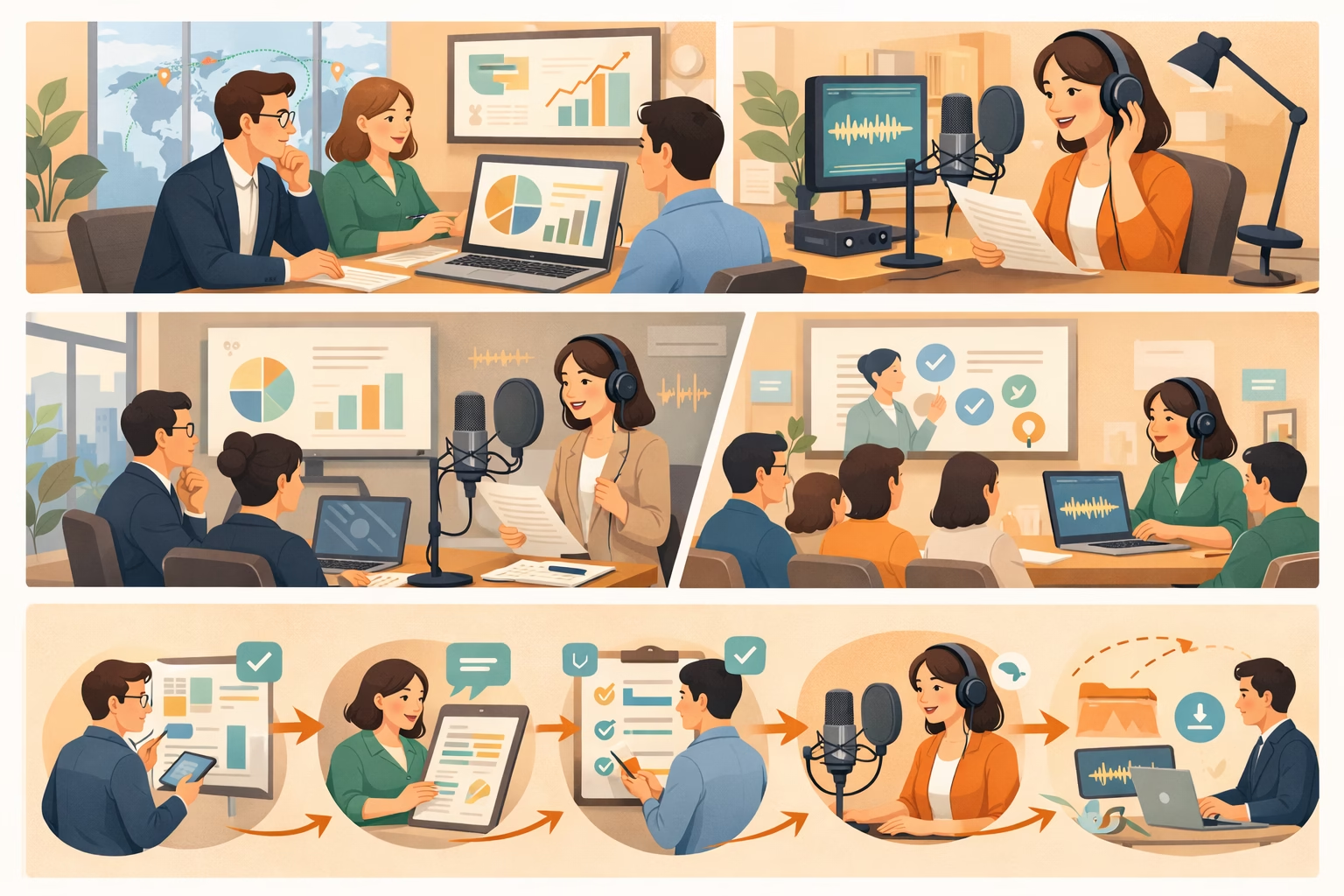
Professional Korean voiceover for presentation work usually means Standard Korean, typically the Seoul standard, combined with the right level of formality for the audience. Voquent explicitly notes that most professional projects use Standard Korean as spoken in Seoul, and that Korean voiceover requires different levels of formality depending on context, with respectful tones commonly used for training and corporate content.
The performance itself should sound controlled rather than theatrical. A good corporate read is usually steady, articulate, and paced to support the slide instead of competing with it. It should feel confident enough for business communication, but natural enough that Korean listeners do not feel they are hearing a translated script.
Should I Use Formal or Informal Tone in Korean Voiceover?
For executives, clients, partners, investors, or mixed external audiences, formal Korean is usually the safer choice. For internal onboarding, product walkthroughs, or employee education, the delivery can sometimes be slightly more conversational, but it still needs to sound polished and professional. That audience-based formality shift is already recognized across Korean voiceover services and is one of the biggest reasons corporate projects benefit from script review before recording.
The wrong tone creates friction fast. If the delivery sounds too stiff, the presentation feels distant. If it sounds too casual, it can reduce credibility. That is why tone should be treated as part of the localization brief, not as a minor performance note.
Different Presentation Types Need Different Reads
The market already treats presentation voiceover as more than one category. Competitive pages split the space into presentations, e-learning narration, corporate videos, internal communications, and product demonstrations, which reflects a real production truth: different business formats require different delivery styles.
Executive or Investor Presentations
For executive updates, partner decks, or investor-facing materials, the voice should sound concise, calm, and assured. The goal is not to impress with personality. It is to reduce friction, reinforce authority, and let the message land cleanly.
Internal Training and Compliance Content
Training content needs a different kind of clarity. LinkedIn’s 2025 Workplace Learning Report says nearly half of learning and talent development professionals report that their executives are concerned employees do not have the right skills to execute business strategy, and 71% of organizations offer leadership training. In other words, learning content is not peripheral anymore. It is tied directly to business readiness.
For compliance or safety-related training, language clarity can become even more serious. OSHA states that employers must instruct employees using a language and vocabulary they can understand. That principle is specific to workplace safety regulation, but it reinforces a broader point that applies across global corporate communication: if people cannot process the message naturally, the content is weaker no matter how polished the slides look.
Product Demos and Walkthrough Presentations
Product demos need stronger pacing control. The read has to support screen flow, feature explanations, and UI-based sequences without sounding robotic. In many cases, this is where English source scripts need the most adaptation, because product naming, button language, and sentence rhythm often do not map cleanly into spoken Korean.
Can You Translate My Script into Korean Before Recording?
Yes, but the better question is this: Can the script be made natural for spoken Korean before recording starts? That is the real issue. Voquent states that it works with native Korean linguists to adapt scripts for tone, style, and context, while DUBnSUB positions Korean corporate and e-learning narration around clarity, consistency, and learner-first delivery. Those are useful benchmarks because they reflect what serious buyers actually need from corporate voice work.
In practice, this usually means checking whether to keep English brand terms, confirming how product names should be pronounced, smoothing long English sentence structures into Korean speech rhythm, and rewriting speaker notes that were never meant to be read word for word. A good Korean presentation script sounds like it was written to be delivered, not just translated to exist.
What to Prepare Before You Record
The easiest way to improve quality and reduce revisions is to send a better brief. Here is the minimum set of materials that usually makes a corporate Korean voiceover project much smoother:
| What to prepare | Why it matters |
|---|---|
| Final English script or speaker notes | Prevents last-minute copy changes after recording |
| Slide deck or screen recording | Helps match pacing, emphasis, and transitions |
| Audience type | Changes tone, formality, and terminology choices |
| Desired voice style | Clarifies whether the read should sound formal, warm, calm, energetic, or instructional |
| Brand terms and pronunciation guide | Avoids inconsistent handling of product names, acronyms, and English terms |
| Timing notes | Important for narrated slides, demos, and training videos |
When clients send these materials upfront, the recording process becomes more strategic. The voice talent is no longer guessing what matters. They are performing against a real communication goal.
How Fast Can a Korean Presentation Voiceover Be Delivered?
Turnaround can be fast, especially for shorter presentation projects. Bunny Studio highlights fast turnaround for Korean presentation voiceover, and Voquent says that most short Korean voiceover projects are delivered within 24 to 48 hours.
But speed depends on what is actually included. A straight read from a finalized Korean script is one kind of job. A corporate presentation that needs translation, spoken-language adaptation, terminology alignment, tone selection, and pickups is another. If the presentation is external-facing, the script stage is where quality is usually won or lost.
That is why the best workflow is often not the fastest raw recording. It is the fastest well-prepared recording.
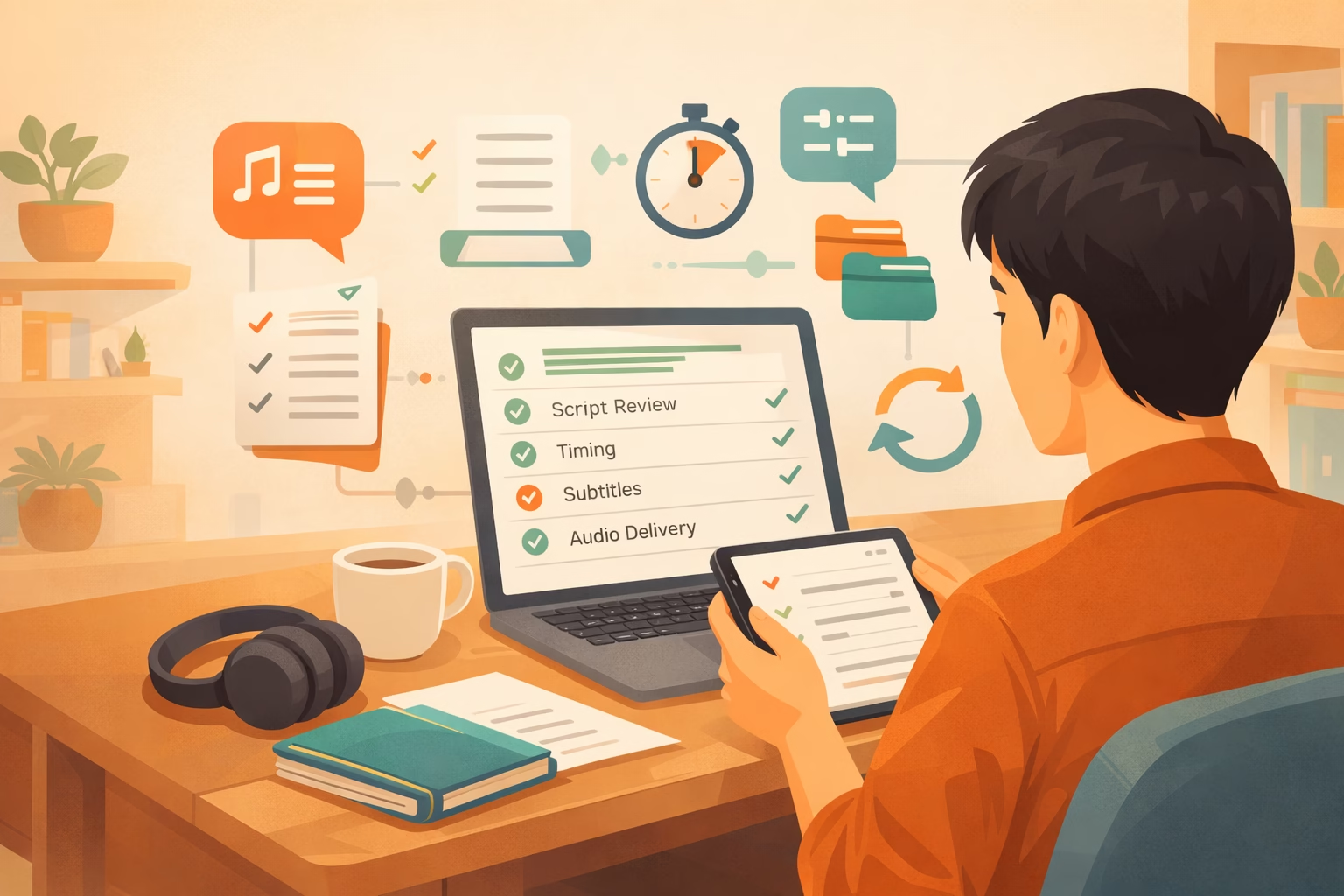
A Better Workflow for Corporate Korean Voiceover
For most presentation projects, a simple five-step process works best:
- Review the source deck and speaker notes
Identify what is being presented, who the audience is, and where the narration will be used. - Adapt the script into natural spoken Korean
Remove literal phrasing and adjust sentence flow for listening, not reading. - Confirm tone, terminology, and pronunciation
Lock in brand language, acronyms, and the right level of formality. - Record clean, presentation-ready audio
Focus on clarity, confidence, and pacing that supports the slide sequence. - Deliver edited files with room for pickups
Make small corrections easy if a slide line or timing cue changes.
This kind of managed workflow lines up with what the market already emphasizes around end-to-end support, script handling, and reliable delivery, but it is more useful for presentation buyers because it is built around the actual communication use case instead of generic “voiceover service” language.
A strong Korean presentation voiceover sits at the intersection of translation, localization, and performance. In a market as digitally mature as South Korea, where internet access, smartphone ownership, and video usage are already near-saturated, presentation content is rarely just visual. It is heard, processed, and judged as a full communication experience.
That is why the right question is not “Can someone read this in Korean?” The better question is “Can this presentation sound credible to Korean listeners?” If you need corporate Korean voiceover for presentations, the most effective approach is to align script adaptation, tone direction, and recording from the start. That is how global teams turn an English-first deck into Korean communication that feels natural, polished, and business-ready.
Need a Korean voiceover for a training deck, business presentation, or product walkthrough? We can help with script adaptation, natural Korean delivery, and presentation-ready audio so your message sounds clear from the first slide to the last.
Conclusion
A strong Korean accent English voice over is not really about “having an accent.” It is about making English sound believable in a Korean context without losing clarity, professionalism, or brand intent.
That is why the best results usually come from a workflow that combines translation, spoken adaptation, performance, editing, and sync support rather than from recording alone. The voice matters, of course, but the process behind the voice matters just as much.
If you need Korean-accented English that still sounds professional, natural, and market-aware, the fastest way to avoid revisions is to start with the right brief and work with someone who can handle both the language side and the performance side together.
Need help with Korean accent English voice over for ads, explainers, e-learning, or localized video content?
Send your script or rough draft, and I can help review whether it needs translation only, spoken adaptation, or full voice-over delivery with sync-ready files.
FAQ
Should I use formal or informal tone in Korean voiceover?
For most corporate presentations, formal Korean is the safer option, especially when the audience includes clients, executives, partners, or investors. For internal training or onboarding content, the tone can be slightly more conversational, but it should still sound polished and professional.
Can you translate my script into Korean before recording?
Yes. But for presentation projects, the goal is not only to translate the script accurately. It is also important to adapt it into natural spoken Korean so the final narration sounds clear, credible, and smooth when delivered aloud.
How fast can a Korean presentation voiceover be delivered?
It depends on the scope. If the Korean script is already finalized, short projects can often be completed quickly. If the project also includes translation, script adaptation, terminology checks, or revision rounds, the turnaround may take longer.